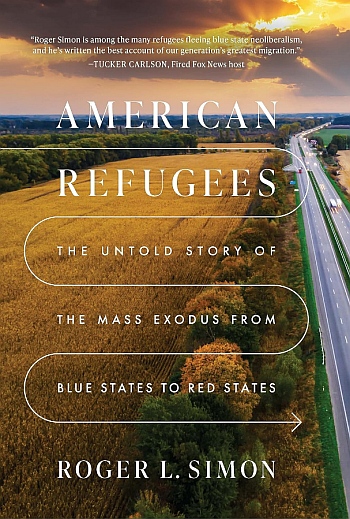
American Refugees is the story of how a culture clash precipitated a great blue state exodus, and what it means for the rest of America. Focusing particularly on Tennessee, Simon contends that only the red states can preserve the constitutional republic envisioned by the Founders. Only they can save America for our children and grandchildren. The struggle will be great, but the story will ultimately have a happy ending.
A net exodus of Americans from blue to red states has been in progress for several years now. This is largely a southbound movement, and perhaps some migrants are “running from the cold up in New England,” as the song goes. But mostly they are leaving states that are too far gone into woke socialism to recover anytime soon—in favor of states with more conservative governance.
The conventional wisdom, or fear, among red state locals is that these newcomers, despite having “voted with their feet,” will continue to vote for the same policies that ruined the states from which they are fleeing. Roger Simon argues that the reverse may be more accurate: blue-to-red migrants tend to be serious constitutional conservatives, and they might be the cavalry that rescues the red states from their own problems.
About Roger
Roger L. Simon is an award-winning novelist, Oscar-nominated screenwriter, co-founder of PJMedia, and now, editor-at-large and columnist for The Epoch Times. He is the author of ten novels, including the Moses Wine detective series, seven produced screenplays and two non-fiction books. He has served as president of the West Coast branch of PEN, a member of the Board of Directors of the Writers Guild of America, and was on the faculty of the American Film Institute and the Sundance Institute. His many journalistic articles have appeared in The New York Times, The Wall Street Journal, The Los Angeles Times, Commentary, Real Clear Politics and City Journal, among others. Mr. Simon has also been a Hoover Institute Media Fellow.
This column was originally published in the Bowling Green Daily News on February 7, 2019, and is being republished here, with the author’s permission.
By Chip Ford
“Kentucky is the worst state in the nation to retire in.”
That’s what I recently heard on WKCT radio early one morning, according to a new WalletHub report.
Kentucky was rated the bottom 50th out of all 50 states — the very worst.
“That’s rubbish,” I said to myself. I’d just arrived in Bowling Green two months before, after extensive research into where I wanted to relocate when I fled Massachusetts. I phoned in to the radio station and disputed that report’s ridiculous conclusion.
I didn’t move here to retire, though I’m not far from it. I moved to escape the extremely high-cost and politically oppressive commonwealth I’ve long battled against. As executive director of Citizens for Limited Taxation, the largest, longest-established taxpayers’ rights group in Massachusetts, after two-plus decades I couldn’t tolerate it much longer. A bolt of inspiration struck out of nowhere late one evening last March: “I don’t need to put up with this, there are options.” My research was launched at that moment.
My criteria were simple. I wanted to find a lower cost-of-living state, with a more temperate climate, with less government control and demands over my life. It could be anywhere else in the country. After weeks of deep research — what I’ve done best for Bay State taxpayers for decades — the result surprised me. The place I wanted to be was Kentucky, specifically Bowling Green.
My decision surprised friends, colleagues, and family even more so. No, I didn’t know anyone there; no, I’ve never been there, had never given Kentucky a passing thought. Though I had a good idea, still I had to pull out a map to find where Kentucky is specifically located among the states. When a colleague saw my reams of research he commented, “I’ll bet you know more about Kentucky now than most of its residents.”
I made three trips to Bowling Green last summer before I found my new home, closed on its purchase in August. Back home in Marblehead I plunged into clearing out and packing up, sold my house and abandoned Massachusetts in mid-November, arrived at my new home 1,100 miles and a few days later.
Eight inches of average winter snowfall here sure beats the annual four feet (a record ten feet in 2015) back there. Before moving I sold my Chevy Blazer with its snowplow and my snowblower — brought along a shovel for emergencies and still haven’t unpacked it.
I’ve never met so many warm, gracious, friendly and helpful people as every single soul I’ve met here so far. Even public employees are friendly and helpful, unlike the typical arrogance and disinterest doled out back there. Instead of standing in long lines for literally hours to register a car or renew a driver’s license at a distant state Registry of Motor Vehicles office, it took twenty minutes here to change over my vehicle registration, another twenty for my driver’s license. And it cost less.
The profit from the sale of my house (mostly market appreciation) more than paid for my similar home in Kentucky. The $6,000 I paid in annual property taxes up there was reduced by 80 percent here. Nobody here wants to ban firearms, or demands permission to own them. Plastic bags and straws are not outlawed. The state legislature doesn’t spend twelve months a year grinding out crazy new laws and raising taxes to pay for them to justify over-paid, alleged full-time legislators, as it does in Massachusetts.
When radio host Chad Young seemed incredulous of my comment about “less government” in Kentucky, I replied: “Everything is relative, and if you were familiar with Massachusetts you’d surely appreciate my perspective. All my friends up there do, and are envious.”
Every morning upon awakening I get a thrill when I realize I’m here, in Kentucky — that I actually pulled it off, escaped the generally endured but needless hardships. I call it “Lucky in Kentucky.”
About Chip
After over three decades of hand-to-hand combat in the political trenches of Massachusetts, Chip escaped to Warren County in 2018. He retired in 2022 as the final executive director of Citizens for Limited Taxation, that state’s most effective taxpayers advocacy group for half a century.
Historically, Warren County is and continues to be a deeply conservative community. But the aspects of our community that most Warren Countians want to conserve are under threat from various forces in our larger culture and from within. That’s why it’s helpful to describe a conservative vision for Warren County, and why it’s so important to rally citizens around that vision.
We are a community that has long been united by a shared Christian faith, an appreciation for the strength and importance of intact, healthy families, and a sense of the common good that unites us even in our differences. Above all, these are the things we seek to conserve.
Faith, Family, and the Common Good. Religious practice and identification have declined somewhat in Warren County, just like in the broader, increasingly secularized culture. But our city and county are still dotted with a web of churches of various kinds and the thick networks of mutual love and support that make up their congregations. Non-Christian faith traditions are welcomed here too, but the Judeo-Christian perspective on God, the family, and the importance of community continue to provide the values and worldview of most Warren Countians.
We should be open and proud about the essentially Christian nature of our county. Public leaders should regularly acknowledge the importance of God in all aspects of our lives and actively encourage church attendance and the observance of religious traditions and promote a public ethos and public policies consistent with Christian ethics.
This means Warren County should continue to be a place for families, where our public policies and public messaging encourages young men and women to marry, stay together, raise children, and hand on our local values to future generations.
It also means we should encourage a strong sense of the common good. Warren County should be a place where people can make money, businesses of various kinds can thrive, ideas of all sorts can be expressed, and peoples of all walks of life are welcome. The diversity of our county is a strength. For decades we have welcomed refugees from some of the most troubled parts of the world and these newcomers are now established, contributing members of the community. But our sense of common purpose is greater than any of our various identities, economic interests, or lifestyles. A common good conservatism for Warren County has further implications for education, safety and order, arts and the environment, and a sustainable local economy.
Education. Warren County is blessed with two well-funded and generally successful public school districts, several faith-based private schools, and a vibrant homeschooling community. However, less than half of students in either public school district are proficient in reading and math. Increasing student achievement needs to be a high priority for our county. We need a much higher level of community engagement in our schools, both in terms of supporting students and in helping educators set an ambitious agenda for improvement.
Conservatives need to be actively involved in the local education system, running for and serving on the local boards of education and school-based decision-making councils. Churches and community groups should partner with schools to provide mentoring, counseling, and other resources to help families eliminate as many barriers to student learning as possible. While we will continue to welcome newcomers to our community with open arms, it is reasonable for local leaders to work with state, federal, and international officials to make sure our intake of refugees is sustainable and does not place undue burdens on our education and social service systems.
Like in most communities, our public schools have lost their original, conservative, purpose: to support parents in forming young people for lives of virtue and passing down to them the best parts of our cultural heritage as Americans and Kentuckians. We must ensure that our schools are safe and orderly environments, where students learn responsibility and respect and disruptions to instruction are not tolerated. We must partner with educators to ensure that students receive a rigorous, content-rich curriculum and science-based reading instruction. Books and instructional materials should be free from divisive ideological concepts.
Because no school, no matter how good, can be the perfect fit for every child, we must promote state policies that allow education dollars to follow students to the school of their family’s choice. Kentucky must fund students, not systems. Local political, education, and community leaders should be champions for school choice. Warren County deserves a rich, diverse education marketplace where every family’s schooling needs can be met according to their values and aspirations for their children.
Western Kentucky University and Southcentral Kentucky Community and Technical College are vitally important components of our education system and local economy. These institutions should reflect the goals and values of the local community and be good partners in forming young people and adults for lives of virtue and satisfying careers that contribute to the common good. Schools should encourage students to consider careers in a wide variety of sectors, including the military and skilled trades and prepare them for any post-secondary opportunity they wish to pursue.
Safety and Order. Warren County is blessed with dedicated first responders and our community deserves well-funded and well-operated police, jail, and fire services. These services are worth a generous public investment, even if that means occasional tax increases. Safety and infrastructure should be among our highest priority investments as a city and county.
Similarly, Warren County should be a child-friendly community. This means ensuring children are shielded from obscenity and other forms of vice, especially in public spaces.
Bowling Green and Warren County need a much more aggressive agenda to deal with homelessness and panhandling, which has reached proportions that threaten the local quality of life. Panhandling should be discouraged and curtailed to the fullest extent allowable by law. Homeless persons should not be allowed to loiter or endanger themselves, other pedestrians, or motorists in intersections and parking lots. We must expand shelters and other services to get homeless persons off the streets, into treatment for their addictions or mental illness, and back into productive lives. These efforts should primarily be driven by churches and charitable organizations, but with coordination, support, and sometimes funding from the city and county governments.
Arts, Beauty, and the Local Environment. A virtuous community values beauty, whether created by humans in the arts or by God in nature. The cultural and natural beauty of Warren County should be defended by conservatives. This means investments in and preservation of arts, parks, and recreation programs, after safety and infrastructure are fully funded. A conservative concern for the natural environment should also extend to private property. Careful zoning policies should insist on buildings with attractive, classical architectural styles and with development rules that protect the visual and functional integrity of neighborhoods. Preservation of historic homes, buildings, and cultural sites should be a conservative priority.
Careful, conservative planning policies should extend to land development outside of the city of Bowling Green. Warren County faces a crisis of affordable housing that should be a major policy priority for local leaders. However, too often in the recent past housing developments have been approved by area officials without sufficient attention to the impact on the natural environment or on infrastructure. Housing development must be better balanced with the preservation of agricultural land. Developers must be responsible for utilities, roads, and other infrastructure investments that will be necessary to support new neighborhoods.
A Sustainable Local Economy. Warren County has long been a regional hub for manufacturing, health care, retail, and dining. The availability of good jobs and our strategic location in the state are key reasons for Warren County’s ongoing population surge. Agriculture is also a historic centerpiece of the county’s economy and should continue to be prioritized, especially sustainable, family-owned farming operations. County leaders should continue their efforts to make the community attractive to high-wage employers in manufacturing, health care, and technology, but an equal emphasis should be placed on the growth and support of small, family-owned businesses. Conservatives should seek a healthy balance in all the various sectors of the local economy and insist that employers provide living wages for the benefit of stable, secure families.
In conclusion, there are many precious things to conserve in Warren County. But we can only preserve what is good in our community if we can name those things and what threatens them. We must be vigilant against economic patterns that erode the beauty and integrity of our families, neighborhoods, and natural environments, and against the corrosive forces of secularism, critical theory, gender ideology, and other far-left ideas that threaten our families, education system, public spaces, and sense of common purpose.
Let us unite to promote a positive, conservative vision for Warren County.
Gary W. Houchens, Ph.D., is professor in the School of Leadership and Professional Studies and Director of the Educational Leadership doctoral program at Western Kentucky University. From 2016-2019 he served as a member of the Kentucky Board of Education.