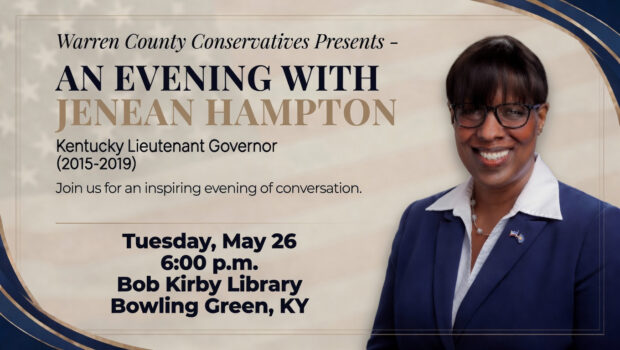
Join Warren County Conservatives for a night of conversation and fellowship with Jenean Hampton Kentucky Lieutenant Governor (2015-2019). Hampton is also a businesswoman, veteran, and unwavering champion of liberty, limited government, and American exceptionalism.
As Kentucky Lieutenant Governor, Jenean was active in veterans affairs, emergency preparedness, aerospace/aviation, and youth suicide prevention. Her heart for education inspired her to start an after-school STEM (Science, Technology, Engineering and Math) program for middle school girls, create a Business Pitch entrepreneurship contest for high school students, and visit over 200 Kentucky schools.
Jenean is a freelance consultant, tapping into 40 years of experience across multiple sectors including government, corrugated packaging, defense and automotive. Her career includes positions as Lieutenant Governor, Chief Operating Officer, Plant Manager, Sales Representative, Production Supervisor and Quality Manager.
Jenean and husband Dr. Doyle Isaak, both U.S. Air Force veterans, have been married 25 years.
Meeting Details: Tuesday, May 26, 2026 @ 6 p.m. Bob Kirby Library, Bowling Green
Free and open to the public. — All conservatives and friends of liberty are welcome!
In March 2026, Warren County Conservatives hosted a Q&A session with the two Republican candidates for Warren County Jailer: Stephen Harmon (Incumbent) and Javen M. Roberson (Challenger).
We are pleased to share the questions asked and each candidate’s response, allowing voters to compare their positions on important issues facing our county, particularly the Warren County Regional Jail.
The Republican primary is set for May 19, 2026. The winner will face no Democratic opponent in the fall general election.
Local government plays a vital role in our communities, and we believe an informed electorate leads to better outcomes. We encourage every Warren County voter to carefully review the candidates’ answers before casting your ballot in the Republican primary.
Stephen Harmon is the current Warren County Jailer, appointed in 2017 and elected in 2018 and 2022. A lifelong Warren County resident with over 26 years in law enforcement, he began his career as a dispatcher at age 18 with the Warren County Sheriff’s Office and rose to division manager in communications. As Jailer, Harmon has focused on modernizing the Warren County Regional Jail, improving public safety, implementing innovative re-entry programs (including the first county jail in Kentucky to offer an inmate ID program), and addressing overcrowding through partnerships and feasibility studies for future expansion.
1. What is your vision for the WCRJ by 2030? (Key objectives) My vision is and has always been to maintain a safe environment for my staff and those in custody, while adhering to state and federal mandates while providing reentry services and programs that have a positive impact on recidivism and prepare inmates for successful reentry upon release.
2. Plans for the future of the jail regarding expansion to meet the projections of BG2050? I recognized the need for additional bed space in the Warren County Regional Jail upon taking office in 2017. I have worked with the Warren Fiscal Court since then on possible solutions. Recently, Judge Executive Doug Gorman assigned a committee to take a closer look at this issue. The committee put out a request for proposals from consulting firms and had six responses. The committee evaluated and interviewed the top three responders. Warren Fiscal Court has hired a consulting firm that will take a comprehensive look at the current facility over a six month period to recommend future options. Ultimately, we know with the growth our county is experiencing, we need to add bed space, but we all want to ensure we do it in the most fiscally responsible way.
3. The jail currently houses inmates from three different classes – Federal inmates awaiting trial / sentencing, State inmates in various stages of incarceration, and County inmates in various stages of incarceration. Many of these are revenue sources for the county jail, but also represent significant pressure on the facility. Are there any plans to change these relationships? The Warren County Regional Jail holds Warren County Inmates, Kentucky Department of Corrections Inmates, United States Marshal Service Inmates, and United States Bureau of Prisons inmates. The state and federal inmates are revenue-generating. A KYDOC Inmate comes with a $35.31 daily per diem from the state. A USMS Federal Inmate comes with a $64.00 daily per diem. The USBOP Inmates per diems depend on whether they are on lock down status, work release status, or home confinement status, but are all revenue generating. We put a lot of resources into running these programs because they are revenue-generating, thus decreasing the amount of general fund tax dollars that are needed to operate the facility. The federal contracts are typically renewed every three years. The funding provided for KYDOC Inmates is set by the legislature. Recently, House Bill 557 was filed and had tremendous support from approximately 50 co-sponsors, Kentucky Associations of Counties, Kentucky Jailer’s Association, Kentucky Judge Executives Association, and the Kentucky Magistrates and Commissioners Association and still didn’t move out of committee during the legislative session. Based on the current budget, the cost per inmate per day is approximately $55.00. This is lower than the average across our Commonwealth and continues to be a financial burden on all county governments. It has been suggested before to consider not housing KYDOC Inmates, but this would have a negative effect on community services crews, inmate kitchen crews, inmate laundry crews, and other programs within the facility. These inmates earned a little money for their work, but more importantly earn time off their sentence while providing work in the facility.
4. How to keep wages and benefits competitive with area employers / other counties, while adding additional staff for a bigger jail? – Follow up – how could outsourcing assist with this? The issue of keeping Deputy Jailer’s salaries competitive with other facilities around us and those our size has always been challenging. I have been able to work with the fiscal court to keep our salaries reasonable for the profession while also staying somewhat competitive with factories and other employers in our area. The issue of employee benefits and insurance plans continues to be an area of focus for us that serve on the insurance committee. As an elected official, I serve on the county insurance committee, and we are constantly looking at ways to be competitive with our employee benefits all while be good stewards of our tax dollars. As for what staffing plans would be necessary related to an expansion, this will have to be evaluated once a plan for expansion is completed. Any staffing plans will be in compliance with what KYDOC requires and that ensures safety and security measures are adhered to.
5. Plans to keep the county tax burdens at a minimum while completing these tasks. All of our efforts related to our normal budgeting process and with whatever future expansion plans the fiscal court has, it will be with the upmost attention to tax dollar stewardship. In this operation, we try to ensure that every tax dollar is stretched as much as possible. We all strive to make sure we are doing all we can with the budget we have. I personally make budgetary decisions with diligence and discernment. This will always be my method as long as I am in office.
6. Plans for managing recidivism, mental health crisis and how to pay for those plans, given many of these programs are for state inmates only. As Jailer, it was my mission to add psychiatric services into our medical department, even though it wasn’t required by Kentucky Jail Standards. We offer an experienced full-time psychiatric nurse in our operation. I made this part of our contract with our medical provider and have extended services since the inception. Recidivism is something that we fight against in all aspects of our operation. My team and I have implemented numerous reentry programs and innovative ways to enhance our reentry efforts and prepare inmates for release back into society. Our facility was the first in the state to have an Inmate ID Program and we pioneered the way for the widely used PreRelease Programming that is now deployed across the state. We have a birth certificate program, social security card program, provide case management, and network with all agencies focused on reentry services to better equip those reintegrating into society. We have had many counties to model their reentry efforts after what we have built in our facility. We offer almost all the evidence based programs that allow for time off the offender’s sentence. These programs are designed for state inmates as county inmates can’t receive any time off of a sentence since they are unsentenced inmates. The state provides incentive funding back to the facilities who provide the evidence based programming which assists with revenue. We will soon be hiring a social worker to assist with our reentry efforts, and this staff member will work closely with the reentry service team and the psychiatric nurse to help provide enhanced reintegration efforts.
7. The profession of Deputy Jailer has more demands and expectations than in the past. What training and investment is planned for new and existing Deputies? Warren County Regional Jail has always provided more training annually than is required by the Kentucky Jail Standards. We provide approximately 200 hours of on the job training to new deputies. In addition to this, training with OC Spray, Taser, firearms, transportation of inmates, first aid CPR / AED, body scanner training, WRAP restraint training, crisis negotiations, de-escalations training, and many more. I was one of the investors in the WRAP Virtual Reality System that was purchased for the jail and the Warren County Sheriff’s Office. This tool provides real-life jail scenario based training. We have nine AEDs in the facility to ensure every housing area has one close if needed and we also have emergency “go-bags” in every housing area. The bags have emergency tools such as Narcan, cutdown tools, CPR masks, and more items to assist in the event of an emergency. We have had special training offered by outside instructors in the area of defensive tactics and crisis negotiations that have added to the training provided by our instructors and the Kentucky Department of Corrections. We are always looking for new trainings to send our instructors to that can bring more information and support back into our operation and outside instructors that offer affordable training opportunities.
8. Do you plan to keep the inmate search history open to the public / available on the internet? How is this currently managed? The current inmate search history on our website is an interface with Jail Tracker, which is our jail management system. This search feature currently provides information that is assessable to the public and is utilized often. I plan to continue the information being available to the public.
9. Giving presents and gifts to inmates / reward system vs strict policies? WCRJ offers several privileges to inmates that are above and beyond what the Kentucky Jail Standards require. These privileges are considered for suspension when rules and regulations are violated.
10. Jail based communications programs, phone access, internet access and tablets? WCRJ currently has Securus as the inmate communication vendor. This system provides offenders the ability to read their mail, text messages, and e-mail type messages from friends and family who initiate these forms of communications with the offender. This system is also utilized for video visitation with friends and family and by clergy. The Securus system also provides tablets for each eligible offender that contains entertainment like books, movies, games, self-help applications, job search applications, and many others. There is free content and for purchase content at the discretion of the offender. There is not an open internet connection for safety and security reasons, these applications are on a closed intranet system hosted by Securus.
11. Since Covid there have been complaints about prisoners having appropriate access to Lawyers, and resources associated with their cases. We have heard this is because of significant resource constraints (mostly physical locations to put them), how are you addressing these issues? The lawsuit that was filed related to restricted access to offenders was frivolous in nature and was dismissed during mediation where I agreed to a couple of modifications to provide further communication for offenders and attorneys. During the pandemic, the only reason that offenders were able to access their attorneys or the courts, was due to our efforts and immediately setting up an electronic system to accommodate hearings and attorney meetings. This was done because of my leadership, not provided by the court system. We provided this system so that the offender’s case could move forward despite the pandemic closing contact with the justice system. Since the pandemic, the state has provided millions of dollars for the implementation of virtual court equipment in jails and courtrooms. This system is utilized today in seven rooms within the facility. This equipment is utilized for federal court hearings, court from other counties, attorney visitation, and evaluations from other professional guests such as social services, drug treatment facilities, and many others. We provide virtual access, face to face access, and through the glass access for attorneys and professional guests to access their clients. We utilize a schedule so we can ensure all visitors have designated times available and that we can accommodate all requests effectively while maintaining safety and security in the facility. We also accommodate “emergency” requests from attorneys and other professional guests. My staff also deliver telephone messages for attorneys who just need their client to call them for a quick conversation regarding their cases. We track all the utilization of the meeting spaces and have availability that is not utilized daily, weekly, and monthly.
12. What goals have you accomplished since taking over as jailer? We have accomplished many goals and are always striving to implement more improvements for Warren County. There many other accomplishments that have been made because of the mission and vision of our agency. Below are some of the many goals we have accomplished are as follows: • We implemented one of the most innovative reentry services staff in the state.
• We implemented one of the most innovative reentry services staff in the state.
• We have increased staff equipment, training, salary and compensation since I took office in 2017.
• We have made many improvements to our aging facility to better accommodate offenders and staff.
• We have implemented enhanced access control equipment.
• We have purchased and installed a body scanner to assist with contraband detention and prevention.
• We have purchased a TruNarc, MX908 trace evidence machine, and a LightLab drug detection device. At the time of purchase, we were the only county jail in the commonwealth to have the TruNarc and the MX908 device in our operation. The LightLab drug detection device is the first machine deployed to any law enforcement agency in our Commonwealth. We have training set up for this new device this summer.
• We implemented a modern jail management system (JailTracker) and utilized capital improvement money from contract negotiations to purchase it, which meant no cost to the general fund.
• We purchased cutting edge technology in portable radios which show a GPS location and utilize cell towers for communications on the radio system providing communciations and making it safer for offenders in transport and on community service crews working out in rural parts of our community.
• We purchased departmental firearms to provide all trained, qualified, and proficient deputies with the same firearm and appropriate level retention holsters. This allowed for streamlined training and equipment on firearms and use of force measures.
• We provided tasers to all staff who were trained, qualified, and proficient with the weapon. We implemented the emergency “gobags”, AEDs, stair-chairs, and other emergency equipment stationed throughout the facility where all offenders are housed for quicker response in an emergency situation.
• We have been able to rotate fleet to ensure that our offenders and staff are in safe vehicles for transportation and for the community work crews.
• We have added significant numbers of security cameras to our operation so now all offender housing areas have camera surveillance.
• We have added bullet resistant windows and pass through boxes at all public locations where staff interact with the public for added safety and security.
• We implemented a medical sensor system that measures respiratory rate and heart rate of all inmates who are isolated and those who are medically fragile.
• We implemented CADMUS, a system that we electronically log all inmate observations and cell checks to be manage compliance with Kentucky Jail Standards.
• We implemented an electronic medical records system to allow medication passes and medical encounters to be handled more effectively and efficiently.
• We executed a plan for an optional work release program called the Felon Equal Employment Directive (FREED) so work eligible inmates are able to work while serving their sentence. This program provides an avenue for inmates to save money to prepare for success reintegration into society.
• We have successfully initiated a peer support program for the staff so that we can better care for each other, overall improving our ability to care of those offenders in our custody.
• We hired a peer support specialist that provides support to those offenders who are in various stages of addiction and recovery that works in our reentry services division. We expanded our home incarceration program providing more staff and resources during the pandemic and since for those who are safe to be supervised in their home and by ankle monitor.
• We have expanded the road crew / community crew program to operate with six crews in our community today.
• We have worked with our contracted food vendor to provide a menu that exceeds state requirements calorie count and provides for more hot meals than required.
13. What goals have you failed to achieve since taking over as jailer? The two main things that have not come to fruition since I took office are adding a social worker and an expansion to address the overcrowding and growth of our community. We continue to work hard on both of the projects and look forward to completing them soon.
Donors / Campaign Finance (Updated April 29, 2026)
Kentucky candidates running for local offices must file periodic campaign finance reports with the Kentucky Registry of Election Finance (KREF).
Stephen Harmon has filed a 30-Day Pre-Primary Report (Report ID 216158) that includes itemized contributions.
Top 10 Itemized Donors:
Amount
Date
Contributor Name
Type
Occupation / Notes
City
State
$500.00
4/10/2026
Tasha Hatcher
Individual
Financial
Bowling Green
KY
$500.00
4/8/2026
Kentucky Realtors PAC
PAC
Realtor Association of Southern KY
Lexington
KY
$500.00
4/7/2026
James Burnette
Individual
Retired
Bowling Green
KY
$500.00
4/2/2026
Jim Martens
Individual
Self-Employed
Alvaton
KY
$250.00
3/20/2026
Jim Bohannon
Individual
Retired
Bowling Green
KY
$200.00
3/26/2026
Bonnie Williams
Individual
Grand Jury Coordinator
Bowling Green
KY
$200.00
3/23/2026
Tod Young
Individual
Officer / Law Enforcement
Alvaton
KY
$125.00
4/16/2026
Timothy Gilliam
Individual
Consultant
Bowling Green
KY
$100.00
4/13/2026
Bob Branstetter
Other_Candidates
Retired
Bowling Green
KY
$100.00
4/7/2026
Sarah Kitchen
Individual
Retired
Bowling Green
KY
Additional Donors: The full report contains 55 total contributions totaling $20,834.06, including self-contributions, smaller individual donations, and in-kind contributions.
Javen M. Roberson is a U.S. Marine Corps veteran, former law enforcement officer. A lifelong Warren County resident, Roberson served 10 years in the Marines, including three combat deployments (two to Iraq and one to Afghanistan), attaining the rank of Sergeant. He later worked as a police officer in multiple agencies across Washington D.C., Georgia, and Colorado before returning home to Bowling Green. Roberson is campaigning on bringing strong leadership, accountability, and operational improvements to the Warren County Regional Jail, with an emphasis on public safety, staff support, and respect.
1. What is your vision for the WCRJ by 2030? (Key objectives) I plan to implement more frequent, effective training for staff so they can perform their duties with confidence, professionalism, and consistency. By ensuring our team is properly prepared, we can reduce preventable mistakes, strengthen operations, and help minimize lawsuits that could otherwise be avoided through better training.
2. Plans for future of the jail regarding expansion to meet the projections of BG2050? The county government has already hired a consulting firm to help address current operational needs. If elected, I plan to provide my input while also incorporating proven policies, strategies, and best practices used by larger cities across the United States to help our jail operate more efficiently, professionally, and smoothly.
3. The Jail currently houses inmates from three different classes – Federal inmates awaiting trial / sentencing, State inmates in various stages of incarceration, County inmates in various stages of incarceration. Many of these are revenue sources for the county jail, but also represent significant pressure on the facility. Are there any plans to change these relationships? We need to study successful jail systems that effectively partner with federal programs and other revenue-generating opportunities that can bring resources back to the county, improve overall operations, and strengthen our jail system—without taking more money out of our residents’ pockets.
4. How to keep wages and benefits competitive with area employers / other counties, while adding additional staff for a bigger jail? – Follow up – how could outsourcing assist with this? We have to create meaningful incentives to attract and retain quality staff, especially when pay may currently be lower than competing opportunities. While working with the County Judge Executive and Magistrates to pursue better wages is important, we also need to offer additional benefits that appeal to today’s workforce—such as bonuses, extra time off, career advancement opportunities, strong uniforms and equipment, and other valuable incentives. We should also build partnerships with local schools and institutions like Western Kentucky University, Southcentral Kentucky Community and Technical College, and other programs throughout Warren County to create direct career pathways into county service. By recruiting locally, offering competitive incentives, and investing in our workforce, we can build a stronger, more reliable team for the future.
Outreach – As far as recruitment outreach, we should take advantage of modern platforms like Facebook, Instagram, and other digital advertising tools to continuously promote employment opportunities within our jail system. Just as campaigns use these platforms to reach voters to say “vote for me” every election cycle we can use them strategically to build and maintain an open pipeline of potential recruits. By consistently advertising careers, benefits, and incentives, we can expand our applicant pool, attract qualified candidates, and create a stronger long-term staffing strategy.
5. Plans to keep the county tax burdens at a minimum while completing these tasks. Recruitment should be an active, ongoing effort. We need designated staff focused specifically on recruiting who can travel to job fairs, schools, and neighboring states, run targeted advertisements, host in-house hiring events, and build partnerships with local universities, colleges, and trade schools—all of which would cost little to none to county taxpayers. These strategies are highly cost-effective while helping us build a stronger, more qualified workforce through consistent outreach and professional recruitment efforts.
6. Plans for managing recidivism, mental health crisis and how to pay for those plans, given many of these programs are for state inmates only. Recidivism is not something fixed with a magic wand. Right now, we’re often teaching the same reentry classes to the same individuals over and over, which clearly shows there is a disconnect somewhere in the system. We need to identify where that breakdown is by studying what other counties and states are doing successfully, while building stronger partnerships with local mental health providers, workforce programs, and community organizations. By focusing on proven strategies, rehabilitation, and outside funding opportunities, we can improve outcomes without placing unnecessary costs on county taxpayers.
7. The profession of Deputy Jailer has more demands and expectations than in the past. What training and investment is planned for new and existing Deputies? Today’s Deputy Jailers face far greater demands than in the past—you can’t simply sit back and monitor from behind a desk anymore. Modern deputies must be trained to a much higher standard, with preparation that closely reflects many of the challenges law enforcement officers face daily. This means investing in frequent, effective training for both new and existing staff, including physical readiness, crisis response, de-escalation, mental health management, and legal standards. Deputies must be properly equipped, supported, and continuously educated—not just physically, but mentally as well—so they can perform their duties confidently, professionally, and safely. By prioritizing strong training, better equipment, and staff support, we can build a more capable workforce while reducing preventable mistakes and minimizing costly lawsuits that impact county taxpayers.
8. Do you plan to keep the inmate search history open to the public / available on the internet? How is this currently managed? Absolutely. We owe it to the people of this county to be as transparent as possible. Public access to inmate search information promotes accountability, builds trust, and ensures families, victims, and community members can access important information. If that transparency is removed, it can create distrust within the community and give the impression that something is being hidden. Everything that can legally and responsibly be made available should be readily accessible for public search, while still protecting necessary privacy and legal standards.
9. Giving presents and gifts to inmates / reward system vs strict policies? I believe both can and should work together. Strict policies are necessary to maintain order, discipline, and safety within the facility, but a structured reward system can also be an effective tool for encouraging good behavior, participation in programs, and personal accountability. Rewards should never replace discipline—they should complement it by reinforcing positive choices. When balanced correctly, strong policies paired with earned incentives can improve inmate behavior, support rehabilitation, and create a safer environment for both staff and inmates.
10. Jail based communications programs, phone access, internet access and tablets? Jail-based communication programs, including phone access, tablets, and any internet-related services, should be limited, closely monitored, and properly recorded. These tools can be valuable for maintaining family connections, legal communication, education, and rehabilitation, but security must always come first. Any access provided should have strict policies, clear oversight, and safeguards in place to prevent abuse, protect the public, and maintain facility safety.
11. Since Covid there have been complaints about prisoners having appropriate access to Lawyers, and resources associated with their cases. We have heard this is because of significant resource constraints (mostly physical locations to put them), how are you addressing these issues? Access to legal counsel is a fundamental right, and inmates must have appropriate opportunities to meet with their attorneys and access case-related resources. The jail is an extension of the judicial system, and attorneys are agents of the courts, so they should be treated as such. COVID restrictions should no longer be used as a blanket excuse for limiting proper legal access. COVID is over, and we either need to return to previously accepted attorney visitation practices or develop improved alternatives—but simply saying accommodations cannot be made is not an acceptable solution. Resource constraints should never justify denying constitutional rights. My approach would be to improve communication, coordination, and facility planning so attorneys, jail staff, and the courts can work together efficiently without unnecessary conflict or legal battles. At the same time, if attorneys—or anyone else—violate the law by attempting to bring in contraband or break facility rules, they should be prosecuted to the fullest extent of the law. Accountability applies to everyone, and legitimate legal access can absolutely coexist with strong security measures. By addressing these issues proactively, we can protect inmate rights, maintain safety, and avoid costly lawsuits.
12. What goals have you accomplished since taking over as jailer? My career has been built through service in law enforcement at multiple levels, and like many officers, advancing into federal service has been a long-term professional goal. I have been actively pursuing opportunities with federal agencies and navigating their extensive background processes, which require careful career decisions. Rather than making a move that could unnecessarily complicate or delay those processes, I chose to focus on my broader law enforcement career path while continuing to prepare myself for leadership. My experience as a Marine, police officer, and public servant has provided me with the operational, leadership, and accountability skills necessary to effectively manage a jail system. This campaign is about bringing proven leadership, fresh ideas, and professional experience to the position—not simply holding a title within the current system.
13. What goals have you failed to achieve since taking over as jailer? Extended hours, overtime, weekends, and high-pressure leadership are nothing new to me—they’ve been a part of my entire adult career. As a United States Marine Infantry Platoon Sergeant, I operated in demanding environments 24 hours a day during combat deployments, where there were no true “off hours.” Whether in Iraq or Afghanistan, I was responsible for the safety, accountability, readiness, and well-being of my Marines at all times. I tracked personnel, equipment, operations, and mission success under extreme pressure.
That experience shaped my leadership philosophy: the people under my command did not work for me—I worked for them. My responsibility was to ensure they had the tools, support, leadership, and resources needed to succeed. I will bring that same servant-leadership approach to the jail. As Jailer, my staff will not work for me—I will work for them, ensuring they are supported, trained, equipped, and positioned to do their jobs effectively while maintaining the highest standards of professionalism and respect.
Donors / Campaign Finance (Updated April 29, 2026)
Kentucky candidates running for local offices must file periodic campaign finance reports with the Kentucky Registry of Election Finance (KREF).
Javen M. Roberson has filed a 30-Day Pre-Primary Report (Report ID 216202) that includes itemized contributions.
Top 10 Itemized Donors:
Amount
Date
Contributor Name
Type
Occupation / Notes
City
State
$560.00
4/6/2026
Southern Lanes, Inc.
Contributing Organization
–
Bowling Green
KY
$400.00
4/6/2026
Wendell Weathers
Individual
Sales
Bowling Green
KY
$400.00
4/6/2026
Nick Lannert
Individual
Superintendent
Bowling Green
KY
$400.00
3/9/2026
Tim Riley
Individual
Basketball Coach
Louisville
KY
$257.54
3/30/2026
Jack Weeks
Individual
Wildland Firefighter
Mammoth Cave
KY
$250.00
3/3/2026
Harold Brantley
Individual
Retired
Bowling Green
KY
$200.00
3/3/2026
Greeneye Properties
Contributing Organization
–
Rockfield
KY
$103.20
4/4/2026
Melissa Robinson
Individual
Retired
Frankfort
KY
$103.20
3/29/2026
Melissa Robinson
Individual
Retired
Frankfort
KY
$50.00
3/24/2026
Catherine Garrison
Individual
Retired
Alvaton
KY
Additional Donors: The full report contains multiple contributions totaling $6,666.56 in monetary receipts (plus $188.50 in in-kind), with significant self-funding and smaller individual donations.
In March 2026, Warren County Conservatives hosted a Q&A session with the two Republican candidates for Magistrate District 4: Rex McWhorter and Terry Hendrick.
We are pleased to share this compilation of the questions asked and each candidate’s response, allowing voters to clearly compare their positions on important issues facing our county.
The Republican primary is set for May 19, 2026, with the winner advancing to face the Democrat challenger, Megan Bailey in the fall general election.
McWhorter, who has served since 2015 (now in his 12th year), emphasizes his record of fiscal responsibility—including balancing budgets annually, lowering taxes multiple times, expanding rural broadband, blacktopping roads, creating full time staffed positions at the Warren County Fire Department to improve response times, enhancing public safety measures like body cameras and school resource officers, and supporting infrastructure and economic growth in one of Kentucky’s fastest-growing counties.
1. What is the most pressing issue facing Warren County right now? What will you do to address it? Trying to manage the rapid growth of Warren County. Infrastructure is always going to be an issue when you have growth, especially rapid growth. As a county we have to maintain our road department, stormwater and water department in order to manage the growth.
2. You’ve served as Magistrate for 12 years. What do you consider your biggest accomplishments? Establishing Warren County Fire with some full-time firefighters to shorten our emergency response times, rural fiber, School Resource Officers, body cameras for the Sheriff’s Department, lowering your taxes 9 of 11 years and listening to my constituents to try to solve problems by working with the road department, stormwater department and the state highway department.
3. A concern we heard is that citizens have a hard time reaching you to address concerns. How do you respond to this? Throughout my nearly 12 years as a magistrate, I have made every effort to answer or return calls from my constituents. I have maintained the same cell phone number, email address, personal and professional Facebook accounts for over 12 years. This contact information has been widely distributed on door hangers and mailers throughout those 12 years. Until about 2 years ago my home phone was listed in the phone book. Anyone can google me and find my information, which includes the Warren County Fiscal Court website with all my information, or by contacting any office at the Warren County Court House. I apologize to anyone who felt like they could not reach me.
4. Warren county has allocated significant resources to address substance abuse. Consequently, other counties send individuals here for treatment, only for many to remain when treatment is complete. Some call this dumping. With high recidivism rates and the added local strain – what would you do to address this? We need to continue to work with the Health Department and other local agencies such as AA and NA to try to ensure that these individuals get the help they need to become productive citizens of Warren County.
5. A proposed animal control ordinance—the first in Warren County history—was presented recently, and is still under review. Do you support this ordinance? How would you change it? The draft of the ordinance has not been completed at this time. There were several changes that were made after conferring with the Agriculture Commissioner Jonathan Shell regarding the wording of the ordinance. I assure you that farm animals will NOT be included in the ordinance. There is no more concrete information about the ordinance at this time.
6. The Warren County Regional Jail faces ongoing overcrowding (with many state and federal prisoners contributing to the population). What policies, advocacy efforts or Fiscal Court actions would you prioritize to reduce capacity issues? Would this include support for raising taxes to fund a new jail if other options fail? Overcrowding is an issue at this time. I think education and job training will have a huge impact in lowering the rate of recidivism, therefore lowering the jail population and help them to become productive, tax paying citizens of Warren County.
7. Amid recent historic flooding events (e.g., April 2025) and ongoing drainage issues in developing areas due to poor stormwater design, what policies would you support on the Fiscal Court to better manage floodwater impacts, improve drainage, and prevent future property damage in Warren County? The stormwater department is working very hard to solve issues such as those seen last April and prevent it from happening again.
8. As a magistrate, you help approve the annual county budget and make decisions that directly affect residents. Under what conditions would you support a tax increase? It would depend on what the funds were needed for and what other options were completely researched and analyzed and found to be insufficient.
9. Transparency and ethical governance are essential. What steps would you take to maintain open communication, public access to meetings, and accountability on the Fiscal Court? Fiscal Court is always open to the public.
10. Rural areas face unique challenges with services and connectivity. Building on past efforts, what would you prioritize to improve quality of life and economic opportunities in District 4? N/A
11. Many voters like to know a candidate’s background with the Republican party. How long have you been a registered Republican? And what inspired you to join the party? I have been a registered Republican for about 15-20 years. Most of my like-minded friends and coworkers were Republicans. It was pretty simple that if I aligned with the conservative party and voted as a conservative, I needed to change my party to align with my values. That party was the Republican Party.
12. There have been several annexations of county land into the City of Bowling Green in recent years, which can affect property taxes, services, and rural character. As Magistrate, what is your position on annexation? The county has no input when it comes to city annexation.
13. Bowling Green and Warren County share many services and face overlapping growth challenges. What are your thoughts on the concept of a merged city-county government? I think it is something we may consider in the future. When that time comes, we weigh the pros and cons and come to a decision based on what is best for the citizens of Warren County.
14. Large-scale developments such as solar farms, data centers, and warehouses often consume significant local resources (including energy, water, and land), can contribute to higher energy prices for residents during peak demand periods, and typically generate few permanent jobs in the community. As Magistrate, what is your overall view on allowing such projects in Warren County, and what specific policies would you support to protect residents from these potential downsides? These large scale developments are discussed at our continuing education meetings we have 4-5 times a year. We interact with county magistrates, county commissioners, and County Judge Executives from around the state. We gather information about things that work and those things that don’t from a lot of outside resource people. At this time, I don’t think Warren County would be able to support any such projects. If it ever comes up for discussion, again we weigh the positive and negative factors and as always come to a decision based on what is best for our county and its citizens.
15. Warren County has seen a lot of farmland converted into subdivisions and new housing developments in recent years, which many residents feel is changing the rural character and way of life we value. Would you support stricter zoning protections for farmland and rural areas, incentives for developers to build in already urbanized zones, standards for fewer houses per acre or lower-density development, or other measures to balance rural life with growing demands for housing? We do need to protect our farmland and rural areas, but I think farmers have the right to sell their land if they so choose.
Donors / Campaign Finance (Updated April 28, 2026)
Kentucky candidates running for local offices must file periodic campaign finance reports with the Kentucky Registry of Election Finance (KREF).
Rex McWhorter Rex McWhorter has filed a 30-Day Pre-Primary Report (Report ID 215665) that includes itemized contributions.
Major Itemized Donors:
Amount
Date
Contributor Name
Occupation
City
State
$2,000.00
4/13/2026
Rex McWhorter (Self)
Candidate
Bowling Green
KY
$1,000.00
3/19/2026
David Elliott
Owner
Bowling Green
KY
$500.00
3/26/2026
Billy Webb
Retired
Smiths Grove
KY
$500.00
3/18/2026
Tony Ferguson
Retired
Tampa
FL
$250.00
4/2/2026
Dustin McWhorter
Accountant
Collierville
TN
$250.00
3/5/2026
William Garske
Owner
Bowling Green
KY
$250.00
3/4/2026
Wilton Houchens, Jr.
Retired
Bowling Green
KY
$200.00
3/9/2026
James Brown
Real Estate Agent
Bowling Green
KY
$200.00
3/2/2026
Brion Holland
Real Estate Agent
Bowling Green
KY
$150.00
3/12/2026
W. Michael Denny
Retired
Bowling Green
KY
$100.00
3/17/2026
Marshall Hughes
Retired
Lewisburg
KY
Additional Donors: The full report contains approximately 45 itemized contributions (many smaller donations of $50–$100).
Hendrick, a retired Bowling Green Municipal Utilities employee and farmer who previously ran as a Democrat in 2022, prioritizes public safety (especially fire and sheriff’s office needs), jail expansion to address overcrowding, and proactive infrastructure improvements like water lines, fire hydrants, and road staffing to manage rapid county growth.
1. How do you differentiate yourself from your opponent. What new ideas do you offer and what would you like to change? Unlike my opponent, I can promise the citizens of the 4th District that I will be out in the community meeting with people and addressing their concerns. I like the idea of hosting community meetings with the district. I would like to have as many department heads within Warren County Government attend these community meetings so that citizens can ask questions and get the best answer possible.
2. In a Daily News article you said that you would focus on jail expansion, enhancing infrastructure and possibly increasing staffing in the county’s road department if you hold this office. Would you vote to raise taxes to accomplish these goals? No. I feel that these tasks could be accomplished without the need to raise taxes.
3. Warren county has allocated significant resources to address substance abuse. Consequently, other counties send individuals here for treatment, only for many to remain when treatment is complete. Some call this dumping. With high recidivism rates and the added local strain – what would you do to address this? My first reaction is to send those individuals back to the county that they came from. Whether or not this is even a possibility is something I don’t know.
4. A proposed animal control ordinance—the first in Warren County history—was presented recently, and is still under review. Do you support this ordinance, how would you change it? I can’t give a complete answer to this question since I have not read the revised animal ordinance, but I am in favor of an ordinance that deals with vicious or nuisance animals. The original ordinance contained statements that had Warren County farmers really upset. If the revised version is viewed as not being harmful to our farmers then I would support it.
5. The Warren County Regional Jail faces ongoing overcrowding (with many state and federal prisoners contributing to the population). What policies, advocacy efforts or Fiscal Court actions would you prioritize to reduce capacity issues? Would this include support for raising taxes to fund a new jail if other options fail? Since the county population is growing at around 15% per year, I don’t know of anything that county government could do to lower jail capacity. If anything, I feel like it’s just going to continue to increase. If the state of Kentucky would pay their fair share for the state inmates housed at the jail that would certainly help a great deal. I think that a new jail is a real possibility in the near future, but no I don’t think that we will have to raise taxes to finance it.
6. Amid recent historic flooding events (e.g., April 2025) and ongoing drainage issues in developing areas due to poor stormwater design, what policies would you support on the Fiscal Court to better manage floodwater impacts, improve drainage, and prevent future property damage in Warren County? The short answer to this is to not build homes in known floodplains. If a home is built in a known floodplain and flooding occurs causing extensive damage to the home then someone besides Warren County Government should be held accountable and Warren County taxpayer’s money should not be used to purchase those homes.
7. As a magistrate, you help approve the annual county budget and make decisions that directly affect residents. Under what conditions would you support a Tax increase? I don’t know of any situation at this time that would be a reason to raise taxes.
8. Transparency and ethical governance are essential. What steps would you take to maintain open communication, public access to meetings, and accountability on the Fiscal Court? As I stated earlier, I am in favor of holding community meetings throughout the 4th District to help keep the citizens informed about what is going on in county government and upcoming projects. Any person in Warren County is welcome to attend fiscal court.
9. Rural areas face unique challenges with services and connectivity. Building on past efforts, what would you prioritize to improve quality of life and economic opportunities in District 4? I feel that much needed, improved infrastructure is essential to improve quality of life and to also provide for more economic opportunities.
10. Many voters like to know a candidate’s background with the Republican party. How long have you been a registered Republican? And what inspired you to join the party? I’ve answered this question no less than four or five times and I feel that everyone that has heard my response has been more than satisfied. It is stated in question 8 that transparency and ethical governance is essential, yet there’s not a single question being asked about why my opponent used taxpayer’s money to buy gravel and then had that gravel delivered and spread at my home church in an obvious effort to buy votes away from me. These activities are both illegal and highly unethical. My comments can be verified by the front page story of the April 5th issue of the Bowling Green Daily News.
11. There have been several annexations of county land into the City of Bowling Green in recent years, which can affect property taxes, services, and rural character. As Magistrate, what is your position on annexation? I’m not happy about the property that is annexed into the city each year since it does have an economic impact on the county. It’s a process that has been happening for many years so I’m not sure if there is a way for county government to control or stop it, but if a solution is presented to fiscal court I would certainly be interest in listening to it.
12. Bowling Green and Warren County share many services and face overlapping growth challenges. What are your thoughts on the concept of a merged city-county government? At the current time I’m not in favor of a merged government, but that is something that would be decided by the voters so who knows what the future holds.
13. Large-scale developments such as solar farms, data centers, and warehouses often consume significant local resources (including energy, water, and land), can contribute to higher energy prices for residents during peak demand periods, and typically generate few permanent jobs in the community. As Magistrate, what is your overall view on allowing such projects in Warren County, and what specific policies would you support to protect residents from these potential downsides? At this time I don’t think that Warren County has a need for any of these developments but no one knows what the needs for the county will be in the future. As far as policies are concerned, I think that guidance would have to come from the county attorney.
14. Warren County has seen a lot of farmland converted into subdivisions and new housing developments in recent years, which many residents feel is changing the rural character and way of life we value. Would you support stricter zoning protections for farmland and rural areas, incentives for developers to build in already urbanized zones, standards for fewer houses per acre or lower-density development, or other measures to balance rural life with growing demands for housing? Since I farm, I personally hate to see the amount of farmland that is being swallowed up for development but I also realize that a landowner has the right to do with his land what he sees fit to do. I would like to see less houses built per acre but I believe that is the responsibility of the City County Planning Commission.
Donors:
According to the Kentucky Registry of Election Finance, Hendrick has accepted no donations for his campaign through April 21, 2026.
In March 2026, Warren County Conservatives hosted a Q&A session with the three Republican candidates for Magistrate District 6: Ron A. Cummings (Incumbent),Rod Hutcheson (Challenger), Justin Gearlds (Challenger).
We are pleased to share this compilation of the questions asked and each candidate’s response, allowing voters to clearly compare their positions on important issues facing our county.
The Republican primary is set for May 19, 2026, with the winner advancing to face the Democrat challenger, Megan Bailey in the fall general election.
Local government plays a vital role in our communities, and we believe an informed electorate leads to better outcomes. We encourage every Warren County voter to carefully review the candidates’ answers before casting your ballot in the Republican primary.
Ron A. Cummings is the current Warren County Magistrate for District 6, first elected in 2018 and serving since 2019. A longtime Warren County resident since 1974, he is a local businessman and real estate broker with Century 21 Premier Realty Partners. Cummings previously served as president of the Realtors Association of South Central Kentucky and emphasizes his experience managing local growth and infrastructure issues.
1. What is the most pressing issue facing Warren County right now. What will you do to address it? Workforce development and engagement is a real issue. We have engaged Southern Kentucky Workforce to enhance recruiting and value proposition. This issue is really important and we must get ahead of this problem. Overall growth issues are also a critical part of Warren County’s future and the current court is very much in front of these issues. Most folks have no clue of how much Fiscal Court helps to navigate our future.
2. You’ve served as Magistrate for 7 years. What do you consider your biggest accomplishments? High speed fiber internet is the biggest addition to Warren County. We began this process in full implementation in middle of 2019 and District 6 was the beginning area to get first. Way before COVID and COVID actually hampered the completion of this project. Other significant accomplishments are Warren County Fire startup, Water & sewer expansions, & quality of life issues like Parks & Recreation improvements and building of Tennis Facility.
3. The impending creation of a new I-65 interchange in District 6 will accelerate growth and require improvements to existing roads connecting to Scottsville Road, Nashville Road, and other routes. How would you preserve quality of life and safety, while addressing existing resident concerns about congestion in District 6? The creation of this new Interchange will be extremely impactful for Southern Warren County, but we need to be extremely judicious in what we allow there. I am for an “Overlay” District to limit what can be done similar to what we did for Exit 26 (Cemetery Road) to ensure the tranquil landscape. This will eliminate unwanted businesses in our rural area. This project will not be done over the next 4 years.
4. Warren county has allocated significant resources to address substance abuse. Consequently other counties send individuals here for treatment, only for many to remain when treatment is complete. Some call this dumping. With high recidivism rates and the added local strain – what would you do to address this? Drug addiction and mental health issues are some of the biggest issues facing America and this flows all the way down to Warren County. Warren County government should NOT be in that business at any level. Private businesses can do and offer whatever services they want without any interference from Warren County Fiscal Court.
5. A proposed animal control ordinance—the first in Warren County history—was presented recently, and is still under review. Do you support this ordinance, how would you change it? I have been on the Committee since this started over 2 years ago and heavily involved with all aspects of its direction. We have a final draft ready and this is expected to be presented in May. We need this ordinance for the citizens of Warren County, while not hurting farmers and farming operations in any way. However, if a farmers dog goes and bites someone, then they should be held liable for their actions like any other citizen. Any ordinance when introduced will have folks on both sides who like or dislike certain aspects, as usual, but this is a vital and necessary ordinance to protect all citizens of Warren County. Currently we do not have anything in place at this time and we have listened to the farmers and other constituents and have drafted something that is impactful and fair to all parties.
6. The Warren County Regional Jail faces ongoing overcrowding (with many state and federal prisoners contributing to the population). What policies, advocacy efforts or Fiscal Court actions would you prioritize to reduce capacity issues? Would this include support for raising taxes to fund a new jail if other options fail? Providing a jail is a Constitutional requirement of each county and we have a great jail and staff. Overcrowding has been an issue long before I came into office and we need to fix this. Federal & State prisoners make a sizeable contribution to the jail’s budget. We (Warren County Fiscal Court) have just hired a consulting firm to look and evaluate all aspects of the jail. It would be prudent to wait until their findings are shared to comment.
7. Amid recent historic flooding events (e.g., April 2025) and ongoing drainage issues in developing areas due to poor stormwater design, what policies would you support on the Fiscal Court to better manage floodwater impacts, improve drainage, and prevent future property damage in Warren County? We (Warren County Fiscal Court) have just signed a 5-year contract along with the City of Bowling Green and WKU to address this particular problem. We must get the data to be able to try to fix the problem. With over 85% of our storm water underground, this is a difficult task to manage. As the data comes in, we will formulate the plan that best addresses this issue. Again like the jail issue, we need the data first and we have already begun work to achieve that process.
8. As a magistrate, you help approve the annual county budget and make decisions that directly affect residents. Under what conditions would you support a Tax increase? We have lowered the tax rate 6 of the last 7 years and the current growth has helped us maintain the services the public wants and expects. But as we grow, the demand for these services will also grow and this demand would be the only way I would ever consider to vote for an increase to cover the basic services we all demand. However, with good spending controls, we should be able to cover these services with no increase in tax rate.
9. Transparency and ethical governance are essential. What steps would you take to maintain open communication, public access to meetings, and accountability on the Fiscal Court? I think we already do an exceptional job in transparency and availability for the citizens of Warren County. I have held 3-5 meetings every year (except COVID year) in all areas of District 6 to communicate and share with folks who attend. I bring the Sheriff and most all department heads of Warren County to answer and address any and all issues. Nothing is off the table and not sure how much more I can do.
10. Rural areas face unique challenges with services and connectivity. Building on past efforts, what would you prioritize to improve quality of life and economic opportunities in District 6? As Warren County grows, Planning & Zoning is a critical and integral part of this process and we are currently working on the Comprehensive plan for the next 25 years. Upon approval and adoption, we must then follow that plan and not allow all the exceptions that currently are taking place. The Future Land Use Map (FLUM) should be well thought out and protected from changes in the future.
11. Many voters like to know a candidate’s background with the Republican party. How long have you been a registered Republican? And what inspired you to join the party? Lifelong Republican. Voted in every election (Primary & General) since I was able. The party of the people.
12. There have been several annexations of county land into the City of Bowling Green in recent years, which can affect property taxes, services, and rural character. As Magistrate, what is your position on annexation? I will oppose any and all plans for annexation into the city. They would be stealing valuable resources and revenue that we need to operate.
13. Bowling Green and Warren County share many services and face overlapping growth challenges. What are your thoughts on the concept of a merged city-county government? Innately against merging, but would consider some aspect of some merged services like Parks & Rec, Fire services, and others if proved beneficial. I do believe we do a great job in being great stewards of County funds and this separation is vital to the Citizens of Warren County. Protecting tax rates is essential to any consideration.
14. Large-scale developments such as solar farms, data centers, and warehouses often consume significant local resources (including energy, water, and land), can contribute to higher energy prices for residents during peak demand periods, and typically generate few permanent jobs in the community. As Magistrate, what is your overall view on allowing such projects in Warren County, and what specific policies would you support to protect residents from these potential downsides? I am against such developments in general. We should stay in the business of recruiting such companies that will bring significant jobs to the County. These potential companies also need to fit in our overall strategies and quality of life issues we so strenuously want to protect. Any potential company needs to “buy-in” to our way of life. Warren County is a special place and I will fight with all my being to protect our way of life.
15. Warren County has seen a lot of farmland converted into subdivisions and new housing developments in recent years, which many residents feel is changing the rural character and way of life we value. Would you support stricter zoning protections for farmland and rural areas, incentives for developers to build in already urbanized zones, standards for fewer houses per acre or lower-density development, or other measures to balance rural life with growing demands for housing? See my answer above regarding Planning & Zoning and the critical role they play in the future of Warren County. I am a HUGE proponent of pushing the development back towards the city and quit the sprawling that is occurring now. This new comprehensive plan will be a vital tool in controlling the direction of future development. I have proposed to the Judge to move the airport to the northern part of the county (develop in conjunction with Barren & Edmonson County – Regional airport) and allow the 600 plus acres currently used at the existing airport to be developed with all the infrastructure already in place. I feel we can put about 35,000 folks in this space. Would be a win-win for all of us.
Donors / Campaign Finance (Updated April 21, 2026)
Kentucky candidates running for local offices must file periodic campaign finance reports with the Kentucky Registry of Election Finance (KREF).
Ron A. Cummings Ron Cummingshas filed a 30-Day Pre-Primary Report (Report ID 427438) that includes itemized contributions.
Major Itemized Donors: Additional Donors: The full report contains approximately 4 itemized contributions (many smaller donations of $200–$1500).
Rod Hutcheson is a real estate agent and general contractor active in the Warren County community. He has served as President of the local Kiwanis Club and on school site-based decision-making councils. Hutcheson is running as a fresh voice focused on responsible growth, public safety, and quality-of-life issues for District 6 residents.
1. What is the most pressing issue facing Warren County right now. What will you do to address it? The most pressing issue is managing rapid growth while maintaining fiscal responsibility. Our infrastructure—roads, drainage, and emergency services—is struggling to keep pace with expansion. I will utilize my background as a general contractor to ensure county projects are managed with maximum efficiency. I will advocate for a managed growth approach where infrastructure improvements are phased in ahead of new developments, rather than playing catch-up, ensuring your tax dollars are spent on long-term solutions, not temporary fixes. It is imperative that we avoid wasteful spending in our Fiscal Court Budget, much like we would in our private business and political campaigns.
2. How do you differentiate yourself from your opponent. What new ideas do you offer and what would you like to change? I offer a unique blend of private sector executive experience and boots on the ground technical knowledge. I offer 30+ years of managing multimillion-dollar budgets in the private sector combined with a licensed real estate agent’s understanding of land use. My time spent with Pfizer, Bayer and Farm Credit provided me with invaluable training in leadership, negotiation, and listening skills among other things. Additionally, my general contractor business has allowed me to see firsthand the issues and challenges that the constituents of the 6th district face. I have a broad network across our community with my involvement in Kiwanis (president), the builder’s association (community involvement committee), the realtors association, Hilltopper Athletic Foundation, Ky Baptist Disaster Relief (Trained & credentialed team leader), Jaycees (SOKY Fair and Christmas Parade), Boy Scouts Annual Fundraising Luncheon, HOA President, SBDM member at South Warren High School, Youth & Church sports coach and security team at Rich Pond Baptist Church. Additionally, I have had a lifelong relationship with Jim Henderson, the Executive Director of the Kentucky Association of Counties. The relationships that I have across our community and state provide additional differentiation among the other candidates. I also think it is important that voters reflect on what a candidate has done historically to gain insight as to what they should expect from them in the future. My background, experience and long history of serving our community is the greatest distinction that I provide.
Regarding new ideas, I think some of that is laid out in responses to other questions, but I would also respond that I think we should make the agenda information more visible to residents. If you currently go to the website to look at the agenda items for the fiscal court meetings it doesn’t give lots of information about the items. I also think we should periodically have fiscal court meetings in the evening to allow people who work to attend. I feel that it is premature to make broad recommendations about what I would change prior to being in the role and gaining insight into what is currently being done.
3. The impending creation of a new I-65 interchange in District 6 will accelerate growth and require improvements to existing roads connecting to Scottsville Road, Nashville Road, and other routes. How would you preserve quality of life and safety, while addressing existing resident concerns about congestion in District 6? The KY 242 interchange is vital for connectivity, but we cannot allow it to turn our local routes into bottlenecks. With the growth projected for Warren County, we need additional access from major highways, particularly to the rapidly growing south part of the county. However, we can’t allow access to negatively impact these things and I would advocate that we begin right of way protections now to ensure that connecting roads to Scottsville and Nashville Road are widened before the interchange opens. By prioritizing safety, including installing proper signaling and turning lanes to prevent the gridlock often seen in high-growth corridors, we can indirectly preserve the quality of life by managing congestion.
4. Warren county has allocated significant resources to address substance abuse. Consequently other counties send individuals here for treatment, only for many to remain when treatment is complete. Some call this dumping. With high recidivism rates and the added local strain – what would you do to address this? We must be a community of compassion, but Warren County cannot be the primary solution for the entire region’s recidivism. I will support policies that require out-of-county agencies to provide Return-to-Origin transportation for individuals upon completion of treatment. We must prioritize our local resources for Warren County residents and focus on vocational training, getting people into the local workforce—to reduce recidivism and the strain on our taxpayers.
5. A proposed animal control ordinance—the first in Warren County history—was presented recently, and is still under review. Do you support this ordinance, how would you change it? I support the intent of a standardized ordinance, but it must be Farm-Friendly. As someone with an agricultural background, I will fight to ensure livestock and working farm dogs are strictly exempt from nuisance definitions intended for residential pets. The ordinance should remain complaint-driven and focus on public safety and responsible ownership without creating a new layer of bureaucracy for our farmers.
6. The Warren County Regional Jail faces ongoing overcrowding (with many state and federal prisoners contributing to the population). What policies, advocacy efforts or Fiscal Court actions would you prioritize to reduce capacity issues? Would this include support for raising taxes to fund a new jail if other options fail? Overcrowding is a fiscal drain and a safety risk. We must lobby the state harder to expedite the transfer of state prisoners to state facilities; Warren County shouldn’t be footing the bill for the state’s backlog. I also think we should conduct a cost/benefit analysis to determine if the lost revenue for housing state prisoners is offset by the impact that contribution has to the fixed cost of operating the jail and the value to the taxpayers for the work that they do. I also think we need to ensure that we are working closely with KACO and state officials to push for increased funding and/or changes to how the county is being reimbursed for state prisoners. Raising taxes for a new jail is a last resort. I would first exhaust all options for regional partnerships and feasibility studies for expanding existing footprints before asking the hardworking citizens of District 6 for more money.
7. Amid recent historic flooding events (e.g., April 2025) and ongoing drainage issues in developing areas due to poor stormwater design, what policies would you support on the Fiscal Court to better manage floodwater impacts, improve drainage, and prevent future property damage in Warren County? As a disaster relief volunteer that worked in the homes of residents in the 6th district, I saw firsthand the impact of the inadequate drainage planning in our community. The April 2025 floods showed that our karst topography requires more than just standard pipe-and-basin design. While not every magistrate voted to compensate some of the homeowners that were directly impacted by the flooding that this caused, I do think that the county bore responsibility for the damage to their homes. I support stricter impact fees for developers in flood-prone areas to fund regional detention basins. We need to move toward a No Adverse Impact policy where new developments are engineered to ensure zero increase in runoff to neighboring properties. It is imperative that Stormwater Management continue to be more proactive in their analysis of the impact of new construction.
8. As a magistrate, you help approve the annual county budget and make decisions that directly affect residents. Under what conditions would you support a Tax increase? As a business owner, I know that you can’t tax your way to prosperity. I would only support a tax increase if there were a demonstrated, catastrophic threat to public safety that cannot be solved through budget reallocation. Even then, I would advocate for a “Sunset Provision” so the tax ends once the specific project is funded.
9. Transparency and ethical governance are essential. What steps would you take to maintain open communication, public access to meetings, and accountability on the Fiscal Court? Government works best when it’s watched. I will maintain my www.magistratehutch.com website to provide constituents with an easy means to communicate with me as well as to provide links to essential county services and information. I will advocate for periodic evening Fiscal Court meetings so working citizens can attend. I also propose increased transparency to spending so that residents can see exactly how county funds are being spent on local road and infrastructure projects in real-time.
10. Rural areas face unique challenges with services and connectivity. Building on past efforts, what would you prioritize to improve quality of life and economic opportunities in District 6? Building on current efforts, I will prioritize the completion of the rural fiber initiative. High-speed internet is no longer a luxury; it’s a utility for our home-based businesses and students. I will also focus on preserving the Rural Character of District 6 by ensuring our volunteer fire departments are fully funded and equipped to handle the unique needs of rural responses. While the new Warren County Fire Department provides significant opportunities for improvements in our ISO rating (and reduced insurance rates), we must continue to recognize the importance and impact of the volunteers on these departments.
11. Many voters like to know a candidate’s background with the Republican party. How long have you been a registered Republican? And what inspired you to join the party? I have been a registered Republican since 2015. Historically in Kentucky democrats were considered to be socially conservative and fiscally moderate. In fact, Democrats in Kentucky in the late 70’s and early 80’s were pro-coal, pro-agriculture and socially traditional. The war on coal era that begin around 2008 and peaked in 2016 along with the party naming Hillary Clinton as its presidential candidate was the last straw. While I have been democrat for many years, I never was a “party” voter. I voted for my conservative values for each office at each and every election. My inspiration comes from the party’s core tenets of individual liberty, fiscal restraint, and the belief that the government closest to the people serves them best. Furthermore, the values of the Republican party by and large align with my personal Christian, conservative values.
12. There have been several annexations of county land into the City of Bowling Green in recent years, which can affect property taxes, services, and rural character. As Magistrate, what is your position on annexation? Annexation should never be a “land grab” that ignores the wishes of current residents. I believe in protecting the rural character of our county. I will advocate for a more collaborative joint land use agreement between the City and County that requires a higher threshold of resident consent and a clear plan for service delivery before any annexation is approved.
13. Bowling Green and Warren County share many services and face overlapping growth challenges. What are your thoughts on the concept of a merged city-county government? While it sounds efficient on paper, a total merger often leads to rural voices being drowned out by urban priorities. I prefer a model of functional consolidation where the city and county could potentially share services like 911 dispatch or purchasing to save money. There is also opportunity, I believe, to share additional services including roads, parks, etc. However, I think it is imperative that we maintain separate legislative bodies to ensure District 6 is never ignored.
14. Large-scale developments such as solar farms, data centers, and warehouses often consume significant local resources (including energy, water, and land), can contribute to higher energy prices for residents during peak demand periods, and typically generate few permanent jobs in the community. As Magistrate, what is your overall view on allowing such projects in Warren County, and what specific policies would you support to protect residents from these potential downsides? I think it is imperative that we conduct a cost benefit analysis on large scale projects that truly evaluate the impact. I am skeptical of projects that consume massive amounts of water and energy while providing few local jobs. Work has already begun by our local agencies to mitigate these types of businesses coming to our area. They have implemented or proposed zoning amendments that require these developers to pay utility impact fees and require a decommissioning bond up-front, so the county isn’t left holding the bag if a solar farm or data center is abandoned.
15. Warren County has seen a lot of farmland converted into subdivisions and new housing developments in recent years, which many residents feel is changing the rural character and way of life we value. Would you support stricter zoning protections for farmland and rural areas, incentives for developers to build in already urbanized zones, standards for fewer houses per acre or lower-density development, or other measures to balance rural life with growing demands for housing? Our farmland is the soul of Warren County. I support incentivizing development in areas where infrastructure already exists rather than pushing further into our agricultural areas. I would also support conservation easements and stricter density requirements in our most sensitive rural zones to ensure our way of life remains intact for our grandchildren. I think that this question is really meant for more than a yes or no answer, even though it is stated as such. While it is a great idea, the Fiscal Court does not have direct control over Planning and Zoning. Planning and zoning appointments are made by both the city and county officials. The mayor of Bowling Green and the County Judge Executive each appoint 4 members, and the cities of Smiths Grove, Woodburn, Plum Springs and Oakland each appoint 1 member.
Donors / Campaign Finance (Updated April 29, 2026)
Kentucky candidates running for local offices must file periodic campaign finance reports with the Kentucky Registry of Election Finance (KREF).
Rod Hutcheson has filed a 30-Day Pre-Primary Report (Report ID 216004) that includes itemized contributions.
Top 10 Itemized Donors:
Amount
Date
Contributor Name
Type
Occupation / Notes
City
State
$2,000.00
2/13/2026
Rod Hutcheson
Self / Candidate
Candidate
Bowling Green
KY
$1,500.00
4/14/2026
Rod Hutcheson
Self / Candidate
Candidate
Bowling Green
KY
$1,000.00
3/31/2026
Rod Hutcheson
Self / Candidate
Candidate
Bowling Green
KY
$500.00
3/10/2026
Robert Hutcheson
Individual
Financial Planner
Elizabethtown
KY
$250.00
3/5/2026
Allen Corder
Individual
Owner Vehicle Repair
Alvaton
KY
$200.00
3/10/2026
Andrew Burt
Individual
Dentist
Bowling Green
KY
$100.00
3/23/2026
Sean Mcguinness
Individual
Retired
Bowling Green
KY
$50.00
4/16/2026
Chris Young
Individual
Credit Officer
Bowling Green
KY
$50.00
3/23/2026
Ronnie Alford
Individual
Farmer
Bowling Green
KY
$25.00
3/23/2026
Debbie Richardson
Individual
Retired
Bowling Green
KY
Additional Donors: The full report contains 18 total contributions totaling $9,975.00, with the majority coming from self-contributions by the candidate.
Justin Gearlds is a local entrepreneur and business owner who operates The Tree Company and Motley Trading Company, a construction business. A political newcomer, Gearlds is campaigning on proactive infrastructure improvements, road maintenance, preserving the county’s agricultural heritage, and increasing housing density through better sewer access to manage Warren County’s rapid growth.
1. What is the most pressing issue facing Warren County right now. What will you do to address it? The most pressing issue facing Warren County right now is growth. Our community is expanding, and with that growth comes new opportunities—but it also brings challenges. We have exceeded parts of our current infrastructure, and if we do not address that now, we risk falling behind in roads, utilities, public services, and long-term planning.
My approach would be smart, responsible growth. That means making sure development happens in a way that protects our quality of life while preparing for the future. We need to invest in infrastructure, improve planning, and ensure growth benefits both longtime residents and new families moving here.
Most importantly, we must be proactive rather than reactive. Instead of waiting until problems arise, we need leadership that anticipates needs, plans ahead, and works with the community to create solutions before issues become crises. Warren County deserves growth that is organized, sustainable, and beneficial for everyone.
2. How do you differentiate yourself from your opponent. What new ideas do you offer and what would you like to change? What differentiates me from my opponent is that I offer a fresh perspective, new energy, and a full-time commitment to serving the people of District 6. I’m younger, highly motivated, and ready to bring proactive leadership that focuses on the future of Warren County.
Unlike someone whose primary profession is elsewhere, if elected this position will be my main responsibility. Public service will not be a side job or secondary source of income for me. I own three successful businesses, and I’ve built strong management teams in each of them so I can dedicate the time and attention this office deserves.
I also believe accessibility matters. I will be reachable, responsive, and committed to following up when constituents bring concerns or issues to me. Too often people feel ignored after an election—I want residents to know they will always have someone willing to listen and work for solutions.
The new ideas I bring center around accountability, communication, and smart growth. Warren County is growing quickly, and we need leadership that is proactive rather than reactive. I want to focus on infrastructure planning, responsible development, and making sure our county services keep pace with growth.
Most importantly, I want to raise the standard of professionalism and integrity in this office. I will always conduct myself with honesty, respect, and transparency, because the people of this district deserve leadership they can trust.
3. The impending creation of a new I-65 interchange in District 6 will accelerate growth and require improvements to existing roads connecting to Scottsville Road, Nashville Road, and other routes. How would you preserve quality of life and safety, while addressing existing resident concerns about congestion in District 6? The new I-65 interchange will bring opportunity, but it will also bring real challenges for District 6. Growth is coming, and if we are not careful, congestion, safety concerns, and overdevelopment could negatively impact the quality of life that current residents value. Not everyone will agree on every decision, but that is exactly why strong leadership and community input will be so important.
My first priority would be addressing the infrastructure issues we already have before adding more strain to roads that are already busy. We need to improve current problem areas, evaluate traffic flow, and make sure existing routes like Scottsville Road, Nashville Road, and connecting county roads can safely handle additional growth. Being proactive now will save taxpayers money and frustration later.
Second, I believe community engagement must lead this process. Residents who live in District 6 deserve a voice in what happens around them. That means bringing together homeowners, business leaders, transportation planners, first responders, and especially our agricultural community. A large part of District 6 is farmland, and farmers deserve to have their concerns heard and respected as plans are developed.
Finally, growth must be smart and responsible. We do not want to lose the character of our community or turn the county into downtown congestion. We need balanced development that protects safety, preserves open space where possible, and keeps District 6 a place families are proud to call home. My goal would be to find practical solutions that work for both current residents and future growth.
4. Warren county has allocated significant resources to address substance abuse. Consequently other counties send individuals here for treatment, only for many to remain when treatment is complete. Some call this dumping. With high recidivism rates and the added local strain – what would you do to address this? I would not characterize this issue as “dumping.” Substance abuse is a regional challenge, and Warren County has become a place where people come for treatment because we have invested in resources that help people rebuild their lives. I believe strongly in second chances. Addiction can affect anyone, and recovery is possible. We should never lose sight of the fact that many people complete treatment, become productive citizens, and go on to make a positive impact in our community. I’ve seen that firsthand through employees who turned their lives around and became valuable, dependable members of the workforce.
At the same time, we must be honest about the strain this can place on local neighborhoods, law enforcement, housing, and public services when planning is not done responsibly. Compassion and accountability have to work together.
My approach would focus on three priorities. First, prevention and education. We need to continue investing in programs that help young people understand the risks of addiction and provide support before substance abuse begins. Second, recovery with accountability. Treatment programs should be measured by outcomes, job placement, and reduced recidivism—not just the number of beds filled. We should encourage partnerships that help people transition into employment and stable living.
Third, smarter zoning and planning. Recovery homes and similar facilities should be placed in appropriate areas with clear standards, rather than concentrated near schools or in neighborhoods that are not designed for them. We need policies that balance recovery opportunities with the quality of life and safety of existing residents.
This issue requires both compassion and common sense. We should continue helping people who want a better life, while making sure Warren County residents are protected and local resources are managed responsibly.
5. A proposed animal control ordinance—the first in Warren County history—was presented recently, and is still under review. Do you support this ordinance, how would you change it? I do support Warren County adopting an animal control ordinance. Public safety has to be a priority, and the recent dog attacks have shown that we need clear standards and stronger enforcement to better protect families, children, and neighborhoods. An ordinance can help establish responsible pet ownership expectations, address dangerous animals, and give authorities the tools they need to respond before serious incidents happen.
At the same time, I believe any ordinance must be practical, fair, and written with Warren County’s unique needs in mind. We are not only a growing suburban community—we also have a strong agricultural community. Farmers and landowners should not be negatively impacted when they are responsibly raising livestock or working animals as part of providing for their families.
If changes are needed, I would focus on making sure the ordinance clearly separates companion animal regulations from normal agricultural operations. It should target neglect, abuse, dangerous situations, and irresponsible ownership—not create unnecessary burdens for those involved in farming or livestock production.
I would also want strong input from residents, animal professionals, farmers, and law enforcement before final adoption. The best ordinance will be one that improves safety, protects animals, respects agriculture, and reflects the values of Warren County.
6. The Warren County Regional Jail faces ongoing overcrowding (with many state and federal prisoners contributing to the population). What policies, advocacy efforts or Fiscal Court actions would you prioritize to reduce capacity issues? Would this include support for raising taxes to fund a new jail if other options fail? Jail overcrowding is a serious issue not just in Warren County, but across many communities. It creates safety concerns, strains staff, increases taxpayer costs, and makes it harder to provide effective rehabilitation. We need practical solutions that address both capacity and the reasons people return to jail.
My first priority would be supporting existing, successful re-entry and recidivism-reduction programs. Too many individuals cycle in and out of the system. We should work with the jail, local employers, treatment providers, and community organizations to help people leaving custody find jobs, treatment, and stability, reducing the likelihood of return.
Second, I would support evaluating alternatives for lower-level, non-violent offenders where appropriate. Programs such as home incarceration, supervised release, or diversion can be more cost-effective than jail beds while still holding individuals accountable and protecting public safety.
Third, Warren County must strongly advocate at the state and federal levels for fair reimbursement rates. If the jail houses state and federal inmates, taxpayers should not be left covering the gap when it costs more to house them than what is being paid. That imbalance has to be addressed.
I also believe the city and county should have honest conversations about shared responsibility. The jail serves the broader community, and local governments should work together on funding solutions that are fair to taxpayers. Cooperation is better than conflict.
With our job growth and new residents moving into the community, we are expanding our tax base. I would prefer to use any increased revenue to support new projects—such as a jail expansion, if needed—while ensuring we are good stewards of tax dollars across all areas of county government. If every other responsible option failed, the public deserves a transparent discussion with clear facts, costs, and accountability before any tax increase is considered.
7. Amid recent historic flooding events (e.g., April 2025) and ongoing drainage issues in developing areas due to poor stormwater design, what policies would you support on the Fiscal Court to better manage floodwater impacts, improve drainage, and prevent future property damage in Warren County? This issue needs immediate attention. Flooding is becoming more frequent, and many families in Warren County have already experienced property damage, road closures, and disruption to daily life. As our county continues to grow, we cannot afford to keep reacting after the fact—we need proactive planning and stronger standards now.
Warren County is in a unique geographic area with caves and karst terrain, which makes stormwater management more complicated than in many other places. Water does not always behave in visible or predictable ways here. It can move underground, pool in unexpected areas, and surface later in places that were not anticipated. Because of that, I would support updated engineering studies, drainage mapping, and better analysis of where water flows both above and below ground before new developments are approved.
I would also support stronger stormwater requirements for new growth. Too often drainage systems are designed to minimum standards that fail during major rain events. We should require larger and more effective retention basins, improved runoff controls, and higher performance standards so developments do not shift flooding problems onto neighboring property owners. If existing standards are not working, they need to be changed.
In addition, I would prioritize maintenance and upgrades to current infrastructure—cleaning ditches, improving culverts, repairing failing drainage systems, and addressing known trouble spots before they become disasters. Preventative maintenance is far less expensive than repeated flood damage.
Most importantly, growth must pay for growth. New development should be part of the solution, not the cause of new drainage problems. My focus would be protecting homeowners, preserving property values, and making sure Warren County grows responsibly with infrastructure that can handle the future.
8. As a magistrate, you help approve the annual county budget and make decisions that directly affect residents. Under what conditions would you support a Tax increase? We are one of the fastest-growing counties in the state, with strong job growth and new residents moving in every day. No one wants higher taxes, and I understand families and businesses already feel the pressure of rising costs. My first priority is making sure taxpayer dollars are spent wisely before asking residents to pay more. The government should seek efficiencies, reduce waste, and plan responsibly.
That said, a growing county has growing needs, and there are limits to how much new property and occupational tax revenue alone can cover. Leadership must be honest about the real costs of providing quality services and infrastructure. Even so, I will not support raising taxes as a first option. Instead, we will:
Run lean budgets, eliminate waste, and pursue operational efficiencies.
Prioritize spending to protect core services and long-term investments.
Seek alternative funding sources (grants, public-private partnerships, regional cost-sharing).
Maintain transparency and strong accountability, so taxpayers know how dollars are used.
My position is simple: be good stewards of existing tax dollars, exhaust every efficiency and alternative funding avenue, and only then responsibly plan for the county’s future without defaulting to higher taxes.
9. Transparency and ethical governance are essential. What steps would you take to maintain open communication, public access to meetings, and accountability on the Fiscal Court? Transparency and ethical governance are not optional—they are essential to earning and keeping the public’s trust. Taxpayers deserve to know how decisions are being made, how their money is being spent, and that their elected officials are acting in the best interest of the community.
First, I would strongly support open communication and public access to Fiscal Court meetings. Residents should be encouraged to attend in person or watch online when available. Public business should be conducted in a way that is easy for citizens to follow, not hidden behind confusion or inconvenience.
Second, agendas, supporting materials, and major budget items should be posted in advance whenever possible so residents have time to review them, ask questions, and stay informed before votes are taken. An informed public creates better government.
Third, I believe taxpayers deserve clear accountability for how their money is spent. That means responsible budgeting, straightforward explanations of major expenditures, and a willingness to answer questions from the public honestly and respectfully.
Finally, elected officials must hold themselves to the highest standards of ethics and professionalism. Public office is a position of trust, and that trust should never be taken lightly. I believe elected leaders should be held to a higher level of accountability, transparency, and conduct than the average citizen because they serve the people.
My commitment would be simple: open doors, honest answers, professional leadership, and decisions made in the daylight for everyone to see.
10. Rural areas face unique challenges with services and connectivity. Building on past efforts, what would you prioritize to improve quality of life and economic opportunities in District 6? Rural areas absolutely face unique challenges, and District 6 deserves the same opportunities and quality of life as any other part of Warren County. As growth continues, we must make sure rural residents are not left behind when it comes to services, infrastructure, and economic opportunity.
One of my top priorities would be making sure every home in Bowling Green and Warren County has access to reliable high-speed internet. Broadband is no longer a luxury—it is essential for education, remote work, small business growth, telehealth, and everyday life. Families should not be limited by where they live when it comes to opportunity.
I would also prioritize improving cellular phone coverage in underserved areas of District 6. Reliable mobile service is important not only for convenience, but also for public safety and emergency response. No resident should struggle to make a call or reach help because of poor signal coverage.
Beyond connectivity, stronger infrastructure creates economic opportunity. When rural communities have dependable internet, communication service, and maintained roads, they become more attractive for new businesses, entrepreneurs, and families who want to live outside the city while still staying connected.
My goal would be to make sure District 6 remains a great place to live while opening new doors for jobs, business growth, and modern services. Rural residents pay taxes too, and they deserve to see those investments reach their communities.
11. Many voters like to know a candidate’s background with the Republican party. How long have you been a registered Republican? And what inspired you to join the party? I have been a registered Republican my entire adult life, and Republican values have been part of my family for generations. My great-grandfather, my grandfather, and my father were all Republicans, so I was raised in a home that valued personal responsibility, faith, hard work, and conservative principles.
My support for the Republican Party is rooted in both family tradition and personal conviction. As I grew older, I chose to remain a Republican because the party’s principles aligned with my own beliefs—limited government, fiscal responsibility, support for law enforcement, economic opportunity, and the importance of individual freedom.
Most importantly, my faith has always guided my values. My biblical principles and Christian beliefs have played a major role in shaping how I view leadership, service, and policy. I believe in protecting families, respecting life, helping those in need, and encouraging accountability and personal responsibility. Those values are what inspired me to stay active in the Republican Party and continue supporting its ideals.
At the end of the day, I believe voters want leaders with consistent values, strong character, and a servant’s heart—and that is what I strive to bring to public service.
12. There have been several annexations of county land into the City of Bowling Green in recent years, which can affect property taxes, services, and rural character. As Magistrate, what is your position on annexation? My general position is that annexation should be approached very carefully and only when there is a clear benefit to the residents directly affected. Too often, annexation can create concerns about higher taxes, changing regulations, and the loss of the rural character that many families value. Those concerns deserve to be taken seriously.
I do not want to see Warren County continually lose land and tax base through unnecessary annexation. When county property is annexed into the City of Bowling Green, the county can lose revenue while still facing growing demands on its budget and services. With already tight budgets, we need to protect as much of the county’s financial stability as possible.
I also believe property owners should have a strong voice in any annexation decision. The people who live there should understand how it impacts taxes, services, zoning, and future development before changes are made. Transparency and local input are essential.
At the same time, city and county governments should work cooperatively rather than competitively. If annexation is proposed, it should be because it truly improves infrastructure, utilities, or services for residents—not simply because it expands boundaries.
My priority as Magistrate would be protecting taxpayers, preserving the character of our communities, and making sure Warren County remains financially strong as we continue to grow.
13. Bowling Green and Warren County share many services and face overlapping growth challenges. What are your thoughts on the concept of a merged city-county government? At this time, I do not believe there is strong public support for a fully merged metro government, and I understand why many residents are cautious about it. People want local representation, accountability, and confidence that their communities would not lose their voice in a larger system. Those concerns are valid and should be respected.
That said, I do not believe in saying “never” to any idea that could benefit taxpayers in the future. As Bowling Green and Warren County continue to grow, we will face increasing pressure on infrastructure, public safety, planning, and budgets. At some point, deeper cooperation or structural changes could become the most efficient option. We should be open-minded enough to study those possibilities rather than dismiss them outright.
Before considering any merger, the public deserves a full and honest review of the pros and cons: costs, savings, representation, service levels, tax impacts, and how it would affect both city and county residents. Education and transparency would be essential.
In the near term, I believe a hybrid approach may make more sense than a full merger. There may be opportunities to share services, coordinate planning, combine certain departments, or improve joint funding agreements while still maintaining separate governments. That kind of practical cooperation could help us manage growth challenges without rushing into a complete metro government.
My position is simple: put taxpayers first, stay open to smart ideas, and make decisions based on facts—not politics.
14. Large-scale developments such as solar farms, data centers, and warehouses often consume significant local resources (including energy, water, and land), can contribute to higher energy prices for residents during peak demand periods, and typically generate few permanent jobs in the community. As Magistrate, what is your overall view on allowing such projects in Warren County, and what specific policies would you support to protect residents from these potential downsides? Large-scale developments such as solar farms, data centers, and major warehouse projects are complex issues, and many residents have legitimate concerns about how they could affect Warren County. These projects can bring investment and expand the tax base, but they can also place heavy demands on utilities, roads, land use, and the character of our communities. That is why they should never be approved automatically or without careful review.
If I had to make the decision today, I would say Warren County is not fully ready for large-scale expansion of these types of projects without stronger planning and safeguards in place first. We need to make sure our infrastructure, zoning standards, and long-term growth strategy are prepared before moving too quickly.
That said, I do not believe in saying “never” to opportunities that could benefit our county in the future. If a project can truly bring responsible investment, increase the tax base, and help fund roads, schools, or other community needs without harming residents, then it deserves fair consideration. But the burden must be on the developer to prove that benefit.
The policies I would support are straightforward. First, growth should pay for growth. Any company seeking to build these facilities should be required to fund the infrastructure upgrades their project creates—whether that is roads, utility expansion, drainage improvements, or public safety needs. Taxpayers should not be left covering those costs.
Second, residents must be protected from quality-of-life impacts. That means careful site selection, setbacks, traffic planning, noise mitigation, environmental review, and transparency about water and energy usage. These projects should not be allowed to lower surrounding property values or disrupt established neighborhoods and farmland.
Third, we need honest public education and input before major decisions are made. Citizens deserve to know the real pros and cons, not just promises. Public meetings and clear facts should come before approvals.
My overall position is this: responsible development can be good, but no project should come to Warren County if it raises taxes, strains local resources, or lowers the quality of life for the people who already live here. Residents must come first.
15. Warren County has seen a lot of farmland converted into subdivisions and new housing developments in recent years, which many residents feel is changing the rural character and way of life we value. Would you support stricter zoning protections for farmland and rural areas, incentives for developers to build in already urbanized zones, standards for fewer houses per acre or lower-density development, or other measures to balance rural life with growing demands for housing? Both residential and commercial growth in rural areas are major concerns, and I understand why many residents feel the character of Warren County is changing too quickly. Growth is coming, but it must be managed in a way that respects farmland, protects infrastructure, and preserves the quality of life that people moved here for in the first place.
My first priority would be using available infill land and redevelopment opportunities inside already urbanized areas before pushing farther into productive farmland and rural communities. We should make better use of land where roads, utilities, and services already exist instead of automatically expanding outward. That is smarter and more cost-effective growth.
If expansion into the county is necessary, I would prefer to see it concentrated along our major transportation corridors such as 31W, 68/80, and 231, where roadway access and utility infrastructure are stronger. Growth should happen where it makes the most practical sense, not scattered in ways that create traffic problems and strain county services.
I also believe new developments should be compatible with the surrounding area. Rural communities should not suddenly be overwhelmed by subdivisions that do not fit the existing landscape or road capacity. Density, lot sizes, buffering, and design standards should reflect the character of the area.
Most importantly, infrastructure must come first—not after the homes are built. Roads, drainage, utilities, schools, and emergency access should be addressed before approvals are granted. Too often government is forced to catch up after development, and taxpayers end up paying the price.
To help preserve farmland long term, I would also support strategic sewer expansion in the right areas so growth can be directed where higher density makes sense, while reducing pressure to sprawl into agricultural land elsewhere.
My overall approach is balanced growth: protect farmland, prioritize infill, build where infrastructure exists, and make sure development pays its own way.
Donors / Campaign Finance (Updated April 29, 2026)
Kentucky candidates running for local offices must file periodic campaign finance reports with the Kentucky Registry of Election Finance (KREF).
Justin Gearlds has filed a 30-Day Pre-Primary Report (Report ID 216267) that includes itemized contributions.
Major Itemized Donors:
Amount
Date
Contributor Name
Type
Occupation
City
State
$17,510.00
3/6/2026
Justin Gearlds
Self
Candidate
–
KY
$10,710.00
4/10/2026
Justin Gearlds
Self
Candidate
–
KY
$6,065.21
4/1/2026
Justin Gearlds
Self
Candidate
–
KY
$3,000.00
3/27/2026
Justin Gearlds
Self
Candidate
–
KY
$1,000.00
2/26/2026
Jacob Schakat
Individual
Golf Professional
Bowling Green
KY
$1,000.00
2/19/2026
Lanny Loague
Individual
Owner
Alvaton
KY
Additional Donors: The full report contains approximately 100+ contributions totaling $65,784.05, with many smaller donations and event fundraising entries.