
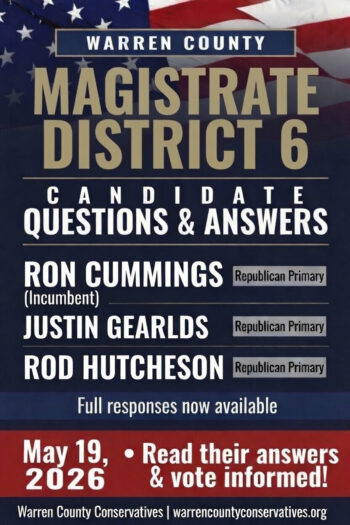
In March 2026, Warren County Conservatives hosted a Q&A session with the three Republican candidates for Magistrate District 6: Ron A. Cummings (Incumbent), Rod Hutcheson (Challenger), Justin Gearlds (Challenger).
We are pleased to share this compilation of the questions asked and each candidate’s response, allowing voters to clearly compare their positions on important issues facing our county.
The Republican primary is set for May 19, 2026, with the winner advancing to face the Democrat challenger, Megan Bailey in the fall general election.
Local government plays a vital role in our communities, and we believe an informed electorate leads to better outcomes. We encourage every Warren County voter to carefully review the candidates’ answers before casting your ballot in the Republican primary.

Ron A. Cummings (Incumbent)
- Facebook Campaign Page: Ron Cummings for Magistrate District 6
Ron A. Cummings is the current Warren County Magistrate for District 6, first elected in 2018 and serving since 2019. A longtime Warren County resident since 1974, he is a local businessman and real estate broker with Century 21 Premier Realty Partners. Cummings previously served as president of the Realtors Association of South Central Kentucky and emphasizes his experience managing local growth and infrastructure issues.
1. What is the most pressing issue facing Warren County right now. What will you do to address it? Workforce development and engagement is a real issue. We have engaged Southern Kentucky Workforce to enhance recruiting and value proposition. This issue is really important and we must get ahead of this problem. Overall growth issues are also a critical part of Warren County’s future and the current court is very much in front of these issues. Most folks have no clue of how much Fiscal Court helps to navigate our future.
2. You’ve served as Magistrate for 7 years. What do you consider your biggest accomplishments? High speed fiber internet is the biggest addition to Warren County. We began this process in full implementation in middle of 2019 and District 6 was the beginning area to get first. Way before COVID and COVID actually hampered the completion of this project. Other significant accomplishments are Warren County Fire startup, Water & sewer expansions, & quality of life issues like Parks & Recreation improvements and building of Tennis Facility.
3. The impending creation of a new I-65 interchange in District 6 will accelerate growth and require improvements to existing roads connecting to Scottsville Road, Nashville Road, and other routes. How would you preserve quality of life and safety, while addressing existing resident concerns about congestion in District 6? The creation of this new Interchange will be extremely impactful for Southern Warren County, but we need to be extremely judicious in what we allow there. I am for an “Overlay” District to limit what can be done similar to what we did for Exit 26 (Cemetery Road) to ensure the tranquil landscape. This will eliminate unwanted businesses in our rural area. This project will not be done over the next 4 years.
4. Warren county has allocated significant resources to address substance abuse. Consequently other counties send individuals here for treatment, only for many to remain when treatment is complete. Some call this dumping. With high recidivism rates and the added local strain – what would you do to address this? Drug addiction and mental health issues are some of the biggest issues facing America and this flows all the way down to Warren County. Warren County government should NOT be in that business at any level. Private businesses can do and offer whatever services they want without any interference from Warren County Fiscal Court.
5. A proposed animal control ordinance—the first in Warren County history—was presented recently, and is still under review. Do you support this ordinance, how would you change it? I have been on the Committee since this started over 2 years ago and heavily involved with all aspects of its direction. We have a final draft ready and this is expected to be presented in May. We need this ordinance for the citizens of Warren County, while not hurting farmers and farming operations in any way. However, if a farmers dog goes and bites someone, then they should be held liable for their actions like any other citizen. Any ordinance when introduced will have folks on both sides who like or dislike certain aspects, as usual, but this is a vital and necessary ordinance to protect all citizens of Warren County. Currently we do not have anything in place at this time and we have listened to the farmers and other constituents and have drafted something that is impactful and fair to all parties.
6. The Warren County Regional Jail faces ongoing overcrowding (with many state and federal prisoners contributing to the population). What policies, advocacy efforts or Fiscal Court actions would you prioritize to reduce capacity issues? Would this include support for raising taxes to fund a new jail if other options fail? Providing a jail is a Constitutional requirement of each county and we have a great jail and staff. Overcrowding has been an issue long before I came into office and we need to fix this. Federal & State prisoners make a sizeable contribution to the jail’s budget. We (Warren County Fiscal Court) have just hired a consulting firm to look and evaluate all aspects of the jail. It would be prudent to wait until their findings are shared to comment.
7. Amid recent historic flooding events (e.g., April 2025) and ongoing drainage issues in developing areas due to poor stormwater design, what policies would you support on the Fiscal Court to better manage floodwater impacts, improve drainage, and prevent future property damage in Warren County? We (Warren County Fiscal Court) have just signed a 5-year contract along with the City of Bowling Green and WKU to address this particular problem. We must get the data to be able to try to fix the problem. With over 85% of our storm water underground, this is a difficult task to manage. As the data comes in, we will formulate the plan that best addresses this issue. Again like the jail issue, we need the data first and we have already begun work to achieve that process.
8. As a magistrate, you help approve the annual county budget and make decisions that directly affect residents. Under what conditions would you support a Tax increase? We have lowered the tax rate 6 of the last 7 years and the current growth has helped us maintain the services the public wants and expects. But as we grow, the demand for these services will also grow and this demand would be the only way I would ever consider to vote for an increase to cover the basic services we all demand. However, with good spending controls, we should be able to cover these services with no increase in tax rate.
9. Transparency and ethical governance are essential. What steps would you take to maintain open communication, public access to meetings, and accountability on the Fiscal Court? I think we already do an exceptional job in transparency and availability for the citizens of Warren County. I have held 3-5 meetings every year (except COVID year) in all areas of District 6 to communicate and share with folks who attend. I bring the Sheriff and most all department heads of Warren County to answer and address any and all issues. Nothing is off the table and not sure how much more I can do.
10. Rural areas face unique challenges with services and connectivity. Building on past efforts, what would you prioritize to improve quality of life and economic opportunities in District 6? As Warren County grows, Planning & Zoning is a critical and integral part of this process and we are currently working on the Comprehensive plan for the next 25 years. Upon approval and adoption, we must then follow that plan and not allow all the exceptions that currently are taking place. The Future Land Use Map (FLUM) should be well thought out and protected from changes in the future.
11. Many voters like to know a candidate’s background with the Republican party. How long have you been a registered Republican? And what inspired you to join the party? Lifelong Republican. Voted in every election (Primary & General) since I was able. The party of the people.
12. There have been several annexations of county land into the City of Bowling Green in recent years, which can affect property taxes, services, and rural character. As Magistrate, what is your position on annexation? I will oppose any and all plans for annexation into the city. They would be stealing valuable resources and revenue that we need to operate.
13. Bowling Green and Warren County share many services and face overlapping growth challenges. What are your thoughts on the concept of a merged city-county government? Innately against merging, but would consider some aspect of some merged services like Parks & Rec, Fire services, and others if proved beneficial. I do believe we do a great job in being great stewards of County funds and this separation is vital to the Citizens of Warren County. Protecting tax rates is essential to any consideration.
14. Large-scale developments such as solar farms, data centers, and warehouses often consume significant local resources (including energy, water, and land), can contribute to higher energy prices for residents during peak demand periods, and typically generate few permanent jobs in the community. As Magistrate, what is your overall view on allowing such projects in Warren County, and what specific policies would you support to protect residents from these potential downsides? I am against such developments in general. We should stay in the business of recruiting such companies that will bring significant jobs to the County. These potential companies also need to fit in our overall strategies and quality of life issues we so strenuously want to protect. Any potential company needs to “buy-in” to our way of life. Warren County is a special place and I will fight with all my being to protect our way of life.
15. Warren County has seen a lot of farmland converted into subdivisions and new housing developments in recent years, which many residents feel is changing the rural character and way of life we value. Would you support stricter zoning protections for farmland and rural areas, incentives for developers to build in already urbanized zones, standards for fewer houses per acre or lower-density development, or other measures to balance rural life with growing demands for housing? See my answer above regarding Planning & Zoning and the critical role they play in the future of Warren County. I am a HUGE proponent of pushing the development back towards the city and quit the sprawling that is occurring now. This new comprehensive plan will be a vital tool in controlling the direction of future development. I have proposed to the Judge to move the airport to the northern part of the county (develop in conjunction with Barren & Edmonson County – Regional airport) and allow the 600 plus acres currently used at the existing airport to be developed with all the infrastructure already in place. I feel we can put about 35,000 folks in this space. Would be a win-win for all of us.
Donors / Campaign Finance (Updated April 21, 2026)
Kentucky candidates running for local offices must file periodic campaign finance reports with the Kentucky Registry of Election Finance (KREF).
Ron A. Cummings Ron Cummingshas filed a 30-Day Pre-Primary Report (Report ID 427438) that includes itemized contributions.
Major Itemized Donors: Additional Donors: The full report contains approximately 4 itemized contributions (many smaller donations of $200–$1500).
View the complete list on all pages:
- Full Itemized Contributors: View All Individual Donations
- PAC Contributions: View PAC Donation
| Amount | Date | Contributor Name | Type | Occupation | City | State |
| $1,500.00 | 4/8/2026 | Realtor Association Of Southern Kentucky | PAC (KYPAC) | – | Bowling Green | KY |
| $500.00 | 4/16/2026 | Robert Ford | Individual | Retired | Bowling Green | KY |
| $200.00 | 4/8/2026 | Timothy Booth | Individual | Retired | Bowling Green | KY |
| $200.00 | 3/11/2026 | Glenn Clark | Individual | Retired | Bowling Green | KY |
Rod Hutcheson (Challenger), Sixth District Magistrate

- Facebook Campaign Page: Rod Hutcheson for Magistrate
- Campaign Website: https://www.magistratehutch.com/
- LinkedIn: Rod Hutcheson
Rod Hutcheson is a real estate agent and general contractor active in the Warren County community. He has served as President of the local Kiwanis Club and on school site-based decision-making councils. Hutcheson is running as a fresh voice focused on responsible growth, public safety, and quality-of-life issues for District 6 residents.
1. What is the most pressing issue facing Warren County right now. What will you do to address it? The most pressing issue is managing rapid growth while maintaining fiscal responsibility. Our infrastructure—roads, drainage, and emergency services—is struggling to keep pace with expansion. I will utilize my background as a general contractor to ensure county projects are managed with maximum efficiency. I will advocate for a managed growth approach where infrastructure improvements are phased in ahead of new developments, rather than playing catch-up, ensuring your tax dollars are spent on long-term solutions, not temporary fixes. It is imperative that we avoid wasteful spending in our Fiscal Court Budget, much like we would in our private business and political campaigns.
2. How do you differentiate yourself from your opponent. What new ideas do you offer and what would you like to change? I offer a unique blend of private sector executive experience and boots on the ground technical knowledge. I offer 30+ years of managing multimillion-dollar budgets in the private sector combined with a licensed real estate agent’s understanding of land use. My time spent with Pfizer, Bayer and Farm Credit provided me with invaluable training in leadership, negotiation, and listening skills among other things. Additionally, my general contractor business has allowed me to see firsthand the issues and challenges that the constituents of the 6th district face. I have a broad network across our community with my involvement in Kiwanis (president), the builder’s association (community involvement committee), the realtors association, Hilltopper Athletic Foundation, Ky Baptist Disaster Relief (Trained & credentialed team leader), Jaycees (SOKY Fair and Christmas Parade), Boy Scouts Annual Fundraising Luncheon, HOA President, SBDM member at South Warren High School, Youth & Church sports coach and security team at Rich Pond Baptist Church. Additionally, I have had a lifelong relationship with Jim Henderson, the Executive Director of the Kentucky Association of Counties. The relationships that I have across our community and state provide additional differentiation among the other candidates. I also think it is important that voters reflect on what a candidate has done historically to gain insight as to what they should expect from them in the future. My background, experience and long history of serving our community is the greatest distinction that I provide.
Regarding new ideas, I think some of that is laid out in responses to other questions, but I would also respond that I think we should make the agenda information more visible to residents. If you currently go to the website to look at the agenda items for the fiscal court meetings it doesn’t give lots of information about the items. I also think we should periodically have fiscal court meetings in the evening to allow people who work to attend. I feel that it is premature to make broad recommendations about what I would change prior to being in the role and gaining insight into what is currently being done.
3. The impending creation of a new I-65 interchange in District 6 will accelerate growth and require improvements to existing roads connecting to Scottsville Road, Nashville Road, and other routes. How would you preserve quality of life and safety, while addressing existing resident concerns about congestion in District 6? The KY 242 interchange is vital for connectivity, but we cannot allow it to turn our local routes into bottlenecks. With the growth projected for Warren County, we need additional access from major highways, particularly to the rapidly growing south part of the county. However, we can’t allow access to negatively impact these things and I would advocate that we begin right of way protections now to ensure that connecting roads to Scottsville and Nashville Road are widened before the interchange opens. By prioritizing safety, including installing proper signaling and turning lanes to prevent the gridlock often seen in high-growth corridors, we can indirectly preserve the quality of life by managing congestion.
4. Warren county has allocated significant resources to address substance abuse. Consequently other counties send individuals here for treatment, only for many to remain when treatment is complete. Some call this dumping. With high recidivism rates and the added local strain – what would you do to address this? We must be a community of compassion, but Warren County cannot be the primary solution for the entire region’s recidivism. I will support policies that require out-of-county agencies to provide Return-to-Origin transportation for individuals upon completion of treatment. We must prioritize our local resources for Warren County residents and focus on vocational training, getting people into the local workforce—to reduce recidivism and the strain on our taxpayers.
5. A proposed animal control ordinance—the first in Warren County history—was presented recently, and is still under review. Do you support this ordinance, how would you change it? I support the intent of a standardized ordinance, but it must be Farm-Friendly. As someone with an agricultural background, I will fight to ensure livestock and working farm dogs are strictly exempt from nuisance definitions intended for residential pets. The ordinance should remain complaint-driven and focus on public safety and responsible ownership without creating a new layer of bureaucracy for our farmers.
6. The Warren County Regional Jail faces ongoing overcrowding (with many state and federal prisoners contributing to the population). What policies, advocacy efforts or Fiscal Court actions would you prioritize to reduce capacity issues? Would this include support for raising taxes to fund a new jail if other options fail? Overcrowding is a fiscal drain and a safety risk. We must lobby the state harder to expedite the transfer of state prisoners to state facilities; Warren County shouldn’t be footing the bill for the state’s backlog. I also think we should conduct a cost/benefit analysis to determine if the lost revenue for housing state prisoners is offset by the impact that contribution has to the fixed cost of operating the jail and the value to the taxpayers for the work that they do. I also think we need to ensure that we are working closely with KACO and state officials to push for increased funding and/or changes to how the county is being reimbursed for state prisoners. Raising taxes for a new jail is a last resort. I would first exhaust all options for regional partnerships and feasibility studies for expanding existing footprints before asking the hardworking citizens of District 6 for more money.
7. Amid recent historic flooding events (e.g., April 2025) and ongoing drainage issues in developing areas due to poor stormwater design, what policies would you support on the Fiscal Court to better manage floodwater impacts, improve drainage, and prevent future property damage in Warren County? As a disaster relief volunteer that worked in the homes of residents in the 6th district, I saw firsthand the impact of the inadequate drainage planning in our community. The April 2025 floods showed that our karst topography requires more than just standard pipe-and-basin design. While not every magistrate voted to compensate some of the homeowners that were directly impacted by the flooding that this caused, I do think that the county bore responsibility for the damage to their homes. I support stricter impact fees for developers in flood-prone areas to fund regional detention basins. We need to move toward a No Adverse Impact policy where new developments are engineered to ensure zero increase in runoff to neighboring properties. It is imperative that Stormwater Management continue to be more proactive in their analysis of the impact of new construction.
8. As a magistrate, you help approve the annual county budget and make decisions that directly affect residents. Under what conditions would you support a Tax increase? As a business owner, I know that you can’t tax your way to prosperity. I would only support a tax increase if there were a demonstrated, catastrophic threat to public safety that cannot be solved through budget reallocation. Even then, I would advocate for a “Sunset Provision” so the tax ends once the specific project is funded.
9. Transparency and ethical governance are essential. What steps would you take to maintain open communication, public access to meetings, and accountability on the Fiscal Court? Government works best when it’s watched. I will maintain my www.magistratehutch.com website to provide constituents with an easy means to communicate with me as well as to provide links to essential county services and information. I will advocate for periodic evening Fiscal Court meetings so working citizens can attend. I also propose increased transparency to spending so that residents can see exactly how county funds are being spent on local road and infrastructure projects in real-time.
10. Rural areas face unique challenges with services and connectivity. Building on past efforts, what would you prioritize to improve quality of life and economic opportunities in District 6? Building on current efforts, I will prioritize the completion of the rural fiber initiative. High-speed internet is no longer a luxury; it’s a utility for our home-based businesses and students. I will also focus on preserving the Rural Character of District 6 by ensuring our volunteer fire departments are fully funded and equipped to handle the unique needs of rural responses. While the new Warren County Fire Department provides significant opportunities for improvements in our ISO rating (and reduced insurance rates), we must continue to recognize the importance and impact of the volunteers on these departments.
11. Many voters like to know a candidate’s background with the Republican party. How long have you been a registered Republican? And what inspired you to join the party? I have been a registered Republican since 2015. Historically in Kentucky democrats were considered to be socially conservative and fiscally moderate. In fact, Democrats in Kentucky in the late 70’s and early 80’s were pro-coal, pro-agriculture and socially traditional. The war on coal era that begin around 2008 and peaked in 2016 along with the party naming Hillary Clinton as its presidential candidate was the last straw. While I have been democrat for many years, I never was a “party” voter. I voted for my conservative values for each office at each and every election. My inspiration comes from the party’s core tenets of individual liberty, fiscal restraint, and the belief that the government closest to the people serves them best. Furthermore, the values of the Republican party by and large align with my personal Christian, conservative values.
12. There have been several annexations of county land into the City of Bowling Green in recent years, which can affect property taxes, services, and rural character. As Magistrate, what is your position on annexation? Annexation should never be a “land grab” that ignores the wishes of current residents. I believe in protecting the rural character of our county. I will advocate for a more collaborative joint land use agreement between the City and County that requires a higher threshold of resident consent and a clear plan for service delivery before any annexation is approved.
13. Bowling Green and Warren County share many services and face overlapping growth challenges. What are your thoughts on the concept of a merged city-county government? While it sounds efficient on paper, a total merger often leads to rural voices being drowned out by urban priorities. I prefer a model of functional consolidation where the city and county could potentially share services like 911 dispatch or purchasing to save money. There is also opportunity, I believe, to share additional services including roads, parks, etc. However, I think it is imperative that we maintain separate legislative bodies to ensure District 6 is never ignored.
14. Large-scale developments such as solar farms, data centers, and warehouses often consume significant local resources (including energy, water, and land), can contribute to higher energy prices for residents during peak demand periods, and typically generate few permanent jobs in the community. As Magistrate, what is your overall view on allowing such projects in Warren County, and what specific policies would you support to protect residents from these potential downsides? I think it is imperative that we conduct a cost benefit analysis on large scale projects that truly evaluate the impact. I am skeptical of projects that consume massive amounts of water and energy while providing few local jobs. Work has already begun by our local agencies to mitigate these types of businesses coming to our area. They have implemented or proposed zoning amendments that require these developers to pay utility impact fees and require a decommissioning bond up-front, so the county isn’t left holding the bag if a solar farm or data center is abandoned.
15. Warren County has seen a lot of farmland converted into subdivisions and new housing developments in recent years, which many residents feel is changing the rural character and way of life we value. Would you support stricter zoning protections for farmland and rural areas, incentives for developers to build in already urbanized zones, standards for fewer houses per acre or lower-density development, or other measures to balance rural life with growing demands for housing? Our farmland is the soul of Warren County. I support incentivizing development in areas where infrastructure already exists rather than pushing further into our agricultural areas. I would also support conservation easements and stricter density requirements in our most sensitive rural zones to ensure our way of life remains intact for our grandchildren. I think that this question is really meant for more than a yes or no answer, even though it is stated as such. While it is a great idea, the Fiscal Court does not have direct control over Planning and Zoning. Planning and zoning appointments are made by both the city and county officials. The mayor of Bowling Green and the County Judge Executive each appoint 4 members, and the cities of Smiths Grove, Woodburn, Plum Springs and Oakland each appoint 1 member.
Donors / Campaign Finance (Updated April 29, 2026)
Kentucky candidates running for local offices must file periodic campaign finance reports with the Kentucky Registry of Election Finance (KREF).
Rod Hutcheson has filed a 30-Day Pre-Primary Report (Report ID 216004) that includes itemized contributions.
Top 10 Itemized Donors:
| Amount | Date | Contributor Name | Type | Occupation / Notes | City | State |
| $2,000.00 | 2/13/2026 | Rod Hutcheson | Self / Candidate | Candidate | Bowling Green | KY |
| $1,500.00 | 4/14/2026 | Rod Hutcheson | Self / Candidate | Candidate | Bowling Green | KY |
| $1,000.00 | 3/31/2026 | Rod Hutcheson | Self / Candidate | Candidate | Bowling Green | KY |
| $500.00 | 3/10/2026 | Robert Hutcheson | Individual | Financial Planner | Elizabethtown | KY |
| $250.00 | 3/5/2026 | Allen Corder | Individual | Owner Vehicle Repair | Alvaton | KY |
| $200.00 | 3/10/2026 | Andrew Burt | Individual | Dentist | Bowling Green | KY |
| $100.00 | 3/23/2026 | Sean Mcguinness | Individual | Retired | Bowling Green | KY |
| $50.00 | 4/16/2026 | Chris Young | Individual | Credit Officer | Bowling Green | KY |
| $50.00 | 3/23/2026 | Ronnie Alford | Individual | Farmer | Bowling Green | KY |
| $25.00 | 3/23/2026 | Debbie Richardson | Individual | Retired | Bowling Green | KY |
Additional Donors: The full report contains 18 total contributions totaling $9,975.00, with the majority coming from self-contributions by the candidate.
View the complete list on all pages: Full Itemized Contributors
Justin Gearlds (Challenger), Sixth District Magistrate

- Facebook Campaign Page: Gearlds for Warren County Magistrate
- Campaign Website: https://www.votegearlds.com/
Justin Gearlds is a local entrepreneur and business owner who operates The Tree Company and Motley Trading Company, a construction business. A political newcomer, Gearlds is campaigning on proactive infrastructure improvements, road maintenance, preserving the county’s agricultural heritage, and increasing housing density through better sewer access to manage Warren County’s rapid growth.
1. What is the most pressing issue facing Warren County right now. What will you do to address it? The most pressing issue facing Warren County right now is growth. Our community is expanding, and with that growth comes new opportunities—but it also brings challenges. We have exceeded parts of our current infrastructure, and if we do not address that now, we risk falling behind in roads, utilities, public services, and long-term planning.
My approach would be smart, responsible growth. That means making sure development happens in a way that protects our quality of life while preparing for the future. We need to invest in infrastructure, improve planning, and ensure growth benefits both longtime residents and new families moving here.
Most importantly, we must be proactive rather than reactive. Instead of waiting until problems arise, we need leadership that anticipates needs, plans ahead, and works with the community to create solutions before issues become crises. Warren County deserves growth that is organized, sustainable, and beneficial for everyone.
2. How do you differentiate yourself from your opponent. What new ideas do you offer and what would you like to change? What differentiates me from my opponent is that I offer a fresh perspective, new energy, and a full-time commitment to serving the people of District 6. I’m younger, highly motivated, and ready to bring proactive leadership that focuses on the future of Warren County.
Unlike someone whose primary profession is elsewhere, if elected this position will be my main responsibility. Public service will not be a side job or secondary source of income for me. I own three successful businesses, and I’ve built strong management teams in each of them so I can dedicate the time and attention this office deserves.
I also believe accessibility matters. I will be reachable, responsive, and committed to following up when constituents bring concerns or issues to me. Too often people feel ignored after an election—I want residents to know they will always have someone willing to listen and work for solutions.
The new ideas I bring center around accountability, communication, and smart growth. Warren County is growing quickly, and we need leadership that is proactive rather than reactive. I want to focus on infrastructure planning, responsible development, and making sure our county services keep pace with growth.
Most importantly, I want to raise the standard of professionalism and integrity in this office. I will always conduct myself with honesty, respect, and transparency, because the people of this district deserve leadership they can trust.
3. The impending creation of a new I-65 interchange in District 6 will accelerate growth and require improvements to existing roads connecting to Scottsville Road, Nashville Road, and other routes. How would you preserve quality of life and safety, while addressing existing resident concerns about congestion in District 6? The new I-65 interchange will bring opportunity, but it will also bring real challenges for District 6. Growth is coming, and if we are not careful, congestion, safety concerns, and overdevelopment could negatively impact the quality of life that current residents value. Not everyone will agree on every decision, but that is exactly why strong leadership and community input will be so important.
My first priority would be addressing the infrastructure issues we already have before adding more strain to roads that are already busy. We need to improve current problem areas, evaluate traffic flow, and make sure existing routes like Scottsville Road, Nashville Road, and connecting county roads can safely handle additional growth. Being proactive now will save taxpayers money and frustration later.
Second, I believe community engagement must lead this process. Residents who live in District 6 deserve a voice in what happens around them. That means bringing together homeowners, business leaders, transportation planners, first responders, and especially our agricultural community. A large part of District 6 is farmland, and farmers deserve to have their concerns heard and respected as plans are developed.
Finally, growth must be smart and responsible. We do not want to lose the character of our community or turn the county into downtown congestion. We need balanced development that protects safety, preserves open space where possible, and keeps District 6 a place families are proud to call home. My goal would be to find practical solutions that work for both current residents and future growth.
4. Warren county has allocated significant resources to address substance abuse. Consequently other counties send individuals here for treatment, only for many to remain when treatment is complete. Some call this dumping. With high recidivism rates and the added local strain – what would you do to address this? I would not characterize this issue as “dumping.” Substance abuse is a regional challenge, and Warren County has become a place where people come for treatment because we have invested in resources that help people rebuild their lives. I believe strongly in second chances. Addiction can affect anyone, and recovery is possible. We should never lose sight of the fact that many people complete treatment, become productive citizens, and go on to make a positive impact in our community. I’ve seen that firsthand through employees who turned their lives around and became valuable, dependable members of the workforce.
At the same time, we must be honest about the strain this can place on local neighborhoods, law enforcement, housing, and public services when planning is not done responsibly. Compassion and accountability have to work together.
My approach would focus on three priorities. First, prevention and education. We need to continue investing in programs that help young people understand the risks of addiction and provide support before substance abuse begins. Second, recovery with accountability. Treatment programs should be measured by outcomes, job placement, and reduced recidivism—not just the number of beds filled. We should encourage partnerships that help people transition into employment and stable living.
Third, smarter zoning and planning. Recovery homes and similar facilities should be placed in appropriate areas with clear standards, rather than concentrated near schools or in neighborhoods that are not designed for them. We need policies that balance recovery opportunities with the quality of life and safety of existing residents.
This issue requires both compassion and common sense. We should continue helping people who want a better life, while making sure Warren County residents are protected and local resources are managed responsibly.
5. A proposed animal control ordinance—the first in Warren County history—was presented recently, and is still under review. Do you support this ordinance, how would you change it? I do support Warren County adopting an animal control ordinance. Public safety has to be a priority, and the recent dog attacks have shown that we need clear standards and stronger enforcement to better protect families, children, and neighborhoods. An ordinance can help establish responsible pet ownership expectations, address dangerous animals, and give authorities the tools they need to respond before serious incidents happen.
At the same time, I believe any ordinance must be practical, fair, and written with Warren County’s unique needs in mind. We are not only a growing suburban community—we also have a strong agricultural community. Farmers and landowners should not be negatively impacted when they are responsibly raising livestock or working animals as part of providing for their families.
If changes are needed, I would focus on making sure the ordinance clearly separates companion animal regulations from normal agricultural operations. It should target neglect, abuse, dangerous situations, and irresponsible ownership—not create unnecessary burdens for those involved in farming or livestock production.
I would also want strong input from residents, animal professionals, farmers, and law enforcement before final adoption. The best ordinance will be one that improves safety, protects animals, respects agriculture, and reflects the values of Warren County.
6. The Warren County Regional Jail faces ongoing overcrowding (with many state and federal prisoners contributing to the population). What policies, advocacy efforts or Fiscal Court actions would you prioritize to reduce capacity issues? Would this include support for raising taxes to fund a new jail if other options fail? Jail overcrowding is a serious issue not just in Warren County, but across many communities. It creates safety concerns, strains staff, increases taxpayer costs, and makes it harder to provide effective rehabilitation. We need practical solutions that address both capacity and the reasons people return to jail.
My first priority would be supporting existing, successful re-entry and recidivism-reduction programs. Too many individuals cycle in and out of the system. We should work with the jail, local employers, treatment providers, and community organizations to help people leaving custody find jobs, treatment, and stability, reducing the likelihood of return.
Second, I would support evaluating alternatives for lower-level, non-violent offenders where appropriate. Programs such as home incarceration, supervised release, or diversion can be more cost-effective than jail beds while still holding individuals accountable and protecting public safety.
Third, Warren County must strongly advocate at the state and federal levels for fair reimbursement rates. If the jail houses state and federal inmates, taxpayers should not be left covering the gap when it costs more to house them than what is being paid. That imbalance has to be addressed.
I also believe the city and county should have honest conversations about shared responsibility. The jail serves the broader community, and local governments should work together on funding solutions that are fair to taxpayers. Cooperation is better than conflict.
With our job growth and new residents moving into the community, we are expanding our tax base. I would prefer to use any increased revenue to support new projects—such as a jail expansion, if needed—while ensuring we are good stewards of tax dollars across all areas of county government. If every other responsible option failed, the public deserves a transparent discussion with clear facts, costs, and accountability before any tax increase is considered.
7. Amid recent historic flooding events (e.g., April 2025) and ongoing drainage issues in developing areas due to poor stormwater design, what policies would you support on the Fiscal Court to better manage floodwater impacts, improve drainage, and prevent future property damage in Warren County? This issue needs immediate attention. Flooding is becoming more frequent, and many families in Warren County have already experienced property damage, road closures, and disruption to daily life. As our county continues to grow, we cannot afford to keep reacting after the fact—we need proactive planning and stronger standards now.
Warren County is in a unique geographic area with caves and karst terrain, which makes stormwater management more complicated than in many other places. Water does not always behave in visible or predictable ways here. It can move underground, pool in unexpected areas, and surface later in places that were not anticipated. Because of that, I would support updated engineering studies, drainage mapping, and better analysis of where water flows both above and below ground before new developments are approved.
I would also support stronger stormwater requirements for new growth. Too often drainage systems are designed to minimum standards that fail during major rain events. We should require larger and more effective retention basins, improved runoff controls, and higher performance standards so developments do not shift flooding problems onto neighboring property owners. If existing standards are not working, they need to be changed.
In addition, I would prioritize maintenance and upgrades to current infrastructure—cleaning ditches, improving culverts, repairing failing drainage systems, and addressing known trouble spots before they become disasters. Preventative maintenance is far less expensive than repeated flood damage.
Most importantly, growth must pay for growth. New development should be part of the solution, not the cause of new drainage problems. My focus would be protecting homeowners, preserving property values, and making sure Warren County grows responsibly with infrastructure that can handle the future.
8. As a magistrate, you help approve the annual county budget and make decisions that directly affect residents. Under what conditions would you support a Tax increase? We are one of the fastest-growing counties in the state, with strong job growth and new residents moving in every day. No one wants higher taxes, and I understand families and businesses already feel the pressure of rising costs. My first priority is making sure taxpayer dollars are spent wisely before asking residents to pay more. The government should seek efficiencies, reduce waste, and plan responsibly.
That said, a growing county has growing needs, and there are limits to how much new property and occupational tax revenue alone can cover. Leadership must be honest about the real costs of providing quality services and infrastructure. Even so, I will not support raising taxes as a first option. Instead, we will:
- Run lean budgets, eliminate waste, and pursue operational efficiencies.
- Prioritize spending to protect core services and long-term investments.
- Seek alternative funding sources (grants, public-private partnerships, regional cost-sharing).
- Maintain transparency and strong accountability, so taxpayers know how dollars are used.
My position is simple: be good stewards of existing tax dollars, exhaust every efficiency and alternative funding avenue, and only then responsibly plan for the county’s future without defaulting to higher taxes.
9. Transparency and ethical governance are essential. What steps would you take to maintain open communication, public access to meetings, and accountability on the Fiscal Court? Transparency and ethical governance are not optional—they are essential to earning and keeping the public’s trust. Taxpayers deserve to know how decisions are being made, how their money is being spent, and that their elected officials are acting in the best interest of the community.
First, I would strongly support open communication and public access to Fiscal Court meetings. Residents should be encouraged to attend in person or watch online when available. Public business should be conducted in a way that is easy for citizens to follow, not hidden behind confusion or inconvenience.
Second, agendas, supporting materials, and major budget items should be posted in advance whenever possible so residents have time to review them, ask questions, and stay informed before votes are taken. An informed public creates better government.
Third, I believe taxpayers deserve clear accountability for how their money is spent. That means responsible budgeting, straightforward explanations of major expenditures, and a willingness to answer questions from the public honestly and respectfully.
Finally, elected officials must hold themselves to the highest standards of ethics and professionalism. Public office is a position of trust, and that trust should never be taken lightly. I believe elected leaders should be held to a higher level of accountability, transparency, and conduct than the average citizen because they serve the people.
My commitment would be simple: open doors, honest answers, professional leadership, and decisions made in the daylight for everyone to see.
10. Rural areas face unique challenges with services and connectivity. Building on past efforts, what would you prioritize to improve quality of life and economic opportunities in District 6? Rural areas absolutely face unique challenges, and District 6 deserves the same opportunities and quality of life as any other part of Warren County. As growth continues, we must make sure rural residents are not left behind when it comes to services, infrastructure, and economic opportunity.
One of my top priorities would be making sure every home in Bowling Green and Warren County has access to reliable high-speed internet. Broadband is no longer a luxury—it is essential for education, remote work, small business growth, telehealth, and everyday life. Families should not be limited by where they live when it comes to opportunity.
I would also prioritize improving cellular phone coverage in underserved areas of District 6. Reliable mobile service is important not only for convenience, but also for public safety and emergency response. No resident should struggle to make a call or reach help because of poor signal coverage.
Beyond connectivity, stronger infrastructure creates economic opportunity. When rural communities have dependable internet, communication service, and maintained roads, they become more attractive for new businesses, entrepreneurs, and families who want to live outside the city while still staying connected.
My goal would be to make sure District 6 remains a great place to live while opening new doors for jobs, business growth, and modern services. Rural residents pay taxes too, and they deserve to see those investments reach their communities.
11. Many voters like to know a candidate’s background with the Republican party. How long have you been a registered Republican? And what inspired you to join the party? I have been a registered Republican my entire adult life, and Republican values have been part of my family for generations. My great-grandfather, my grandfather, and my father were all Republicans, so I was raised in a home that valued personal responsibility, faith, hard work, and conservative principles.
My support for the Republican Party is rooted in both family tradition and personal conviction. As I grew older, I chose to remain a Republican because the party’s principles aligned with my own beliefs—limited government, fiscal responsibility, support for law enforcement, economic opportunity, and the importance of individual freedom.
Most importantly, my faith has always guided my values. My biblical principles and Christian beliefs have played a major role in shaping how I view leadership, service, and policy. I believe in protecting families, respecting life, helping those in need, and encouraging accountability and personal responsibility. Those values are what inspired me to stay active in the Republican Party and continue supporting its ideals.
At the end of the day, I believe voters want leaders with consistent values, strong character, and a servant’s heart—and that is what I strive to bring to public service.
12. There have been several annexations of county land into the City of Bowling Green in recent years, which can affect property taxes, services, and rural character. As Magistrate, what is your position on annexation? My general position is that annexation should be approached very carefully and only when there is a clear benefit to the residents directly affected. Too often, annexation can create concerns about higher taxes, changing regulations, and the loss of the rural character that many families value. Those concerns deserve to be taken seriously.
I do not want to see Warren County continually lose land and tax base through unnecessary annexation. When county property is annexed into the City of Bowling Green, the county can lose revenue while still facing growing demands on its budget and services. With already tight budgets, we need to protect as much of the county’s financial stability as possible.
I also believe property owners should have a strong voice in any annexation decision. The people who live there should understand how it impacts taxes, services, zoning, and future development before changes are made. Transparency and local input are essential.
At the same time, city and county governments should work cooperatively rather than competitively. If annexation is proposed, it should be because it truly improves infrastructure, utilities, or services for residents—not simply because it expands boundaries.
My priority as Magistrate would be protecting taxpayers, preserving the character of our communities, and making sure Warren County remains financially strong as we continue to grow.
13. Bowling Green and Warren County share many services and face overlapping growth challenges. What are your thoughts on the concept of a merged city-county government? At this time, I do not believe there is strong public support for a fully merged metro government, and I understand why many residents are cautious about it. People want local representation, accountability, and confidence that their communities would not lose their voice in a larger system. Those concerns are valid and should be respected.
That said, I do not believe in saying “never” to any idea that could benefit taxpayers in the future. As Bowling Green and Warren County continue to grow, we will face increasing pressure on infrastructure, public safety, planning, and budgets. At some point, deeper cooperation or structural changes could become the most efficient option. We should be open-minded enough to study those possibilities rather than dismiss them outright.
Before considering any merger, the public deserves a full and honest review of the pros and cons: costs, savings, representation, service levels, tax impacts, and how it would affect both city and county residents. Education and transparency would be essential.
In the near term, I believe a hybrid approach may make more sense than a full merger. There may be opportunities to share services, coordinate planning, combine certain departments, or improve joint funding agreements while still maintaining separate governments. That kind of practical cooperation could help us manage growth challenges without rushing into a complete metro government.
My position is simple: put taxpayers first, stay open to smart ideas, and make decisions based on facts—not politics.
14. Large-scale developments such as solar farms, data centers, and warehouses often consume significant local resources (including energy, water, and land), can contribute to higher energy prices for residents during peak demand periods, and typically generate few permanent jobs in the community. As Magistrate, what is your overall view on allowing such projects in Warren County, and what specific policies would you support to protect residents from these potential downsides? Large-scale developments such as solar farms, data centers, and major warehouse projects are complex issues, and many residents have legitimate concerns about how they could affect Warren County. These projects can bring investment and expand the tax base, but they can also place heavy demands on utilities, roads, land use, and the character of our communities. That is why they should never be approved automatically or without careful review.
If I had to make the decision today, I would say Warren County is not fully ready for large-scale expansion of these types of projects without stronger planning and safeguards in place first. We need to make sure our infrastructure, zoning standards, and long-term growth strategy are prepared before moving too quickly.
That said, I do not believe in saying “never” to opportunities that could benefit our county in the future. If a project can truly bring responsible investment, increase the tax base, and help fund roads, schools, or other community needs without harming residents, then it deserves fair consideration. But the burden must be on the developer to prove that benefit.
The policies I would support are straightforward. First, growth should pay for growth. Any company seeking to build these facilities should be required to fund the infrastructure upgrades their project creates—whether that is roads, utility expansion, drainage improvements, or public safety needs. Taxpayers should not be left covering those costs.
Second, residents must be protected from quality-of-life impacts. That means careful site selection, setbacks, traffic planning, noise mitigation, environmental review, and transparency about water and energy usage. These projects should not be allowed to lower surrounding property values or disrupt established neighborhoods and farmland.
Third, we need honest public education and input before major decisions are made. Citizens deserve to know the real pros and cons, not just promises. Public meetings and clear facts should come before approvals.
My overall position is this: responsible development can be good, but no project should come to Warren County if it raises taxes, strains local resources, or lowers the quality of life for the people who already live here. Residents must come first.
15. Warren County has seen a lot of farmland converted into subdivisions and new housing developments in recent years, which many residents feel is changing the rural character and way of life we value. Would you support stricter zoning protections for farmland and rural areas, incentives for developers to build in already urbanized zones, standards for fewer houses per acre or lower-density development, or other measures to balance rural life with growing demands for housing? Both residential and commercial growth in rural areas are major concerns, and I understand why many residents feel the character of Warren County is changing too quickly. Growth is coming, but it must be managed in a way that respects farmland, protects infrastructure, and preserves the quality of life that people moved here for in the first place.
My first priority would be using available infill land and redevelopment opportunities inside already urbanized areas before pushing farther into productive farmland and rural communities. We should make better use of land where roads, utilities, and services already exist instead of automatically expanding outward. That is smarter and more cost-effective growth.
If expansion into the county is necessary, I would prefer to see it concentrated along our major transportation corridors such as 31W, 68/80, and 231, where roadway access and utility infrastructure are stronger. Growth should happen where it makes the most practical sense, not scattered in ways that create traffic problems and strain county services.
I also believe new developments should be compatible with the surrounding area. Rural communities should not suddenly be overwhelmed by subdivisions that do not fit the existing landscape or road capacity. Density, lot sizes, buffering, and design standards should reflect the character of the area.
Most importantly, infrastructure must come first—not after the homes are built. Roads, drainage, utilities, schools, and emergency access should be addressed before approvals are granted. Too often government is forced to catch up after development, and taxpayers end up paying the price.
To help preserve farmland long term, I would also support strategic sewer expansion in the right areas so growth can be directed where higher density makes sense, while reducing pressure to sprawl into agricultural land elsewhere.
My overall approach is balanced growth: protect farmland, prioritize infill, build where infrastructure exists, and make sure development pays its own way.
Donors / Campaign Finance (Updated April 29, 2026)
Kentucky candidates running for local offices must file periodic campaign finance reports with the Kentucky Registry of Election Finance (KREF).
Justin Gearlds has filed a 30-Day Pre-Primary Report (Report ID 216267) that includes itemized contributions.
Major Itemized Donors:
| Amount | Date | Contributor Name | Type | Occupation | City | State |
| $17,510.00 | 3/6/2026 | Justin Gearlds | Self | Candidate | – | KY |
| $10,710.00 | 4/10/2026 | Justin Gearlds | Self | Candidate | – | KY |
| $6,065.21 | 4/1/2026 | Justin Gearlds | Self | Candidate | – | KY |
| $3,000.00 | 3/27/2026 | Justin Gearlds | Self | Candidate | – | KY |
| $1,000.00 | 2/26/2026 | Jacob Schakat | Individual | Golf Professional | Bowling Green | KY |
| $1,000.00 | 2/19/2026 | Lanny Loague | Individual | Owner | Alvaton | KY |
Additional Donors: The full report contains approximately 100+ contributions totaling $65,784.05, with many smaller donations and event fundraising entries.
View the complete list on all pages: