
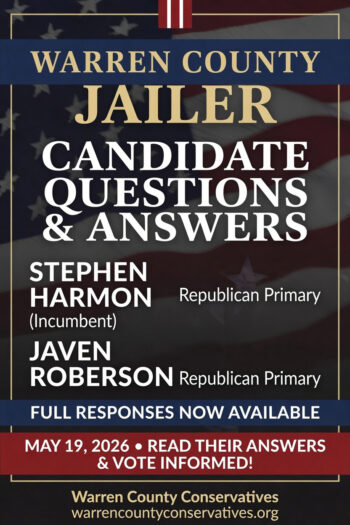
In March 2026, Warren County Conservatives hosted a Q&A session with the two Republican candidates for Warren County Jailer: Stephen Harmon (Incumbent) and Javen M. Roberson (Challenger).
We are pleased to share the questions asked and each candidate’s response, allowing voters to compare their positions on important issues facing our county, particularly the Warren County Regional Jail.
The Republican primary is set for May 19, 2026. The winner will face no Democratic opponent in the fall general election.
Local government plays a vital role in our communities, and we believe an informed electorate leads to better outcomes. We encourage every Warren County voter to carefully review the candidates’ answers before casting your ballot in the Republican primary.
Stephen Harmon (Incumbent)
- Campaign Website: jailerharmon.com
- Facebook Campaign Page: Harmon for Jailer

Stephen Harmon is the current Warren County Jailer, appointed in 2017 and elected in 2018 and 2022. A lifelong Warren County resident with over 26 years in law enforcement, he began his career as a dispatcher at age 18 with the Warren County Sheriff’s Office and rose to division manager in communications. As Jailer, Harmon has focused on modernizing the Warren County Regional Jail, improving public safety, implementing innovative re-entry programs (including the first county jail in Kentucky to offer an inmate ID program), and addressing overcrowding through partnerships and feasibility studies for future expansion.
1. What is your vision for the WCRJ by 2030? (Key objectives) My vision is and has always been to maintain a safe environment for my staff and those in custody, while adhering to state and federal mandates while providing reentry services and programs that have a positive impact on recidivism and prepare inmates for successful reentry upon release.
2. Plans for the future of the jail regarding expansion to meet the projections of BG2050? I recognized the need for additional bed space in the Warren County Regional Jail upon taking office in 2017. I have worked with the Warren Fiscal Court since then on possible solutions. Recently, Judge Executive Doug Gorman assigned a committee to take a closer look at this issue. The committee put out a request for proposals from consulting firms and had six responses. The committee evaluated and interviewed the top three responders. Warren Fiscal Court has hired a consulting firm that will take a comprehensive look at the current facility over a six month period to recommend future options. Ultimately, we know with the growth our county is experiencing, we need to add bed space, but we all want to ensure we do it in the most fiscally responsible way.
3. The jail currently houses inmates from three different classes – Federal inmates awaiting trial / sentencing, State inmates in various stages of incarceration, and County inmates in various stages of incarceration. Many of these are revenue sources for the county jail, but also represent significant pressure on the facility. Are there any plans to change these relationships? The Warren County Regional Jail holds Warren County Inmates, Kentucky Department of Corrections Inmates, United States Marshal Service Inmates, and United States Bureau of Prisons inmates. The state and federal inmates are revenue-generating. A KYDOC Inmate comes with a $35.31 daily per diem from the state. A USMS Federal Inmate comes with a $64.00 daily per diem. The USBOP Inmates per diems depend on whether they are on lock down status, work release status, or home confinement status, but are all revenue generating. We put a lot of resources into running these programs because they are revenue-generating, thus decreasing the amount of general fund tax dollars that are needed to operate the facility. The federal contracts are typically renewed every three years. The funding provided for KYDOC Inmates is set by the legislature. Recently, House Bill 557 was filed and had tremendous support from approximately 50 co-sponsors, Kentucky Associations of Counties, Kentucky Jailer’s Association, Kentucky Judge Executives Association, and the Kentucky Magistrates and Commissioners Association and still didn’t move out of committee during the legislative session. Based on the current budget, the cost per inmate per day is approximately $55.00. This is lower than the average across our Commonwealth and continues to be a financial burden on all county governments. It has been suggested before to consider not housing KYDOC Inmates, but this would have a negative effect on community services crews, inmate kitchen crews, inmate laundry crews, and other programs within the facility. These inmates earned a little money for their work, but more importantly earn time off their sentence while providing work in the facility.
4. How to keep wages and benefits competitive with area employers / other counties, while adding additional staff for a bigger jail? – Follow up – how could outsourcing assist with this? The issue of keeping Deputy Jailer’s salaries competitive with other facilities around us and those our size has always been challenging. I have been able to work with the fiscal court to keep our salaries reasonable for the profession while also staying somewhat competitive with factories and other employers in our area. The issue of employee benefits and insurance plans continues to be an area of focus for us that serve on the insurance committee. As an elected official, I serve on the county insurance committee, and we are constantly looking at ways to be competitive with our employee benefits all while be good stewards of our tax dollars. As for what staffing plans would be necessary related to an expansion, this will have to be evaluated once a plan for expansion is completed. Any staffing plans will be in compliance with what KYDOC requires and that ensures safety and security measures are adhered to.
5. Plans to keep the county tax burdens at a minimum while completing these tasks. All of our efforts related to our normal budgeting process and with whatever future expansion plans the fiscal court has, it will be with the upmost attention to tax dollar stewardship. In this operation, we try to ensure that every tax dollar is stretched as much as possible. We all strive to make sure we are doing all we can with the budget we have. I personally make budgetary decisions with diligence and discernment. This will always be my method as long as I am in office.
6. Plans for managing recidivism, mental health crisis and how to pay for those plans, given many of these programs are for state inmates only. As Jailer, it was my mission to add psychiatric services into our medical department, even though it wasn’t required by Kentucky Jail Standards. We offer an experienced full-time psychiatric nurse in our operation. I made this part of our contract with our medical provider and have extended services since the inception. Recidivism is something that we fight against in all aspects of our operation. My team and I have implemented numerous reentry programs and innovative ways to enhance our reentry efforts and prepare inmates for release back into society. Our facility was the first in the state to have an Inmate ID Program and we pioneered the way for the widely used PreRelease Programming that is now deployed across the state. We have a birth certificate program, social security card program, provide case management, and network with all agencies focused on reentry services to better equip those reintegrating into society. We have had many counties to model their reentry efforts after what we have built in our facility. We offer almost all the evidence based programs that allow for time off the offender’s sentence. These programs are designed for state inmates as county inmates can’t receive any time off of a sentence since they are unsentenced inmates. The state provides incentive funding back to the facilities who provide the evidence based programming which assists with revenue. We will soon be hiring a social worker to assist with our reentry efforts, and this staff member will work closely with the reentry service team and the psychiatric nurse to help provide enhanced reintegration efforts.
7. The profession of Deputy Jailer has more demands and expectations than in the past. What training and investment is planned for new and existing Deputies? Warren County Regional Jail has always provided more training annually than is required by the Kentucky Jail Standards. We provide approximately 200 hours of on the job training to new deputies. In addition to this, training with OC Spray, Taser, firearms, transportation of inmates, first aid CPR / AED, body scanner training, WRAP restraint training, crisis negotiations, de-escalations training, and many more. I was one of the investors in the WRAP Virtual Reality System that was purchased for the jail and the Warren County Sheriff’s Office. This tool provides real-life jail scenario based training. We have nine AEDs in the facility to ensure every housing area has one close if needed and we also have emergency “go-bags” in every housing area. The bags have emergency tools such as Narcan, cutdown tools, CPR masks, and more items to assist in the event of an emergency. We have had special training offered by outside instructors in the area of defensive tactics and crisis negotiations that have added to the training provided by our instructors and the Kentucky Department of Corrections. We are always looking for new trainings to send our instructors to that can bring more information and support back into our operation and outside instructors that offer affordable training opportunities.
8. Do you plan to keep the inmate search history open to the public / available on the internet? How is this currently managed? The current inmate search history on our website is an interface with Jail Tracker, which is our jail management system. This search feature currently provides information that is assessable to the public and is utilized often. I plan to continue the information being available to the public.
9. Giving presents and gifts to inmates / reward system vs strict policies? WCRJ offers several privileges to inmates that are above and beyond what the Kentucky Jail Standards require. These privileges are considered for suspension when rules and regulations are violated.
10. Jail based communications programs, phone access, internet access and tablets? WCRJ currently has Securus as the inmate communication vendor. This system provides offenders the ability to read their mail, text messages, and e-mail type messages from friends and family who initiate these forms of communications with the offender. This system is also utilized for video visitation with friends and family and by clergy. The Securus system also provides tablets for each eligible offender that contains entertainment like books, movies, games, self-help applications, job search applications, and many others. There is free content and for purchase content at the discretion of the offender. There is not an open internet connection for safety and security reasons, these applications are on a closed intranet system hosted by Securus.
11. Since Covid there have been complaints about prisoners having appropriate access to Lawyers, and resources associated with their cases. We have heard this is because of significant resource constraints (mostly physical locations to put them), how are you addressing these issues? The lawsuit that was filed related to restricted access to offenders was frivolous in nature and was dismissed during mediation where I agreed to a couple of modifications to provide further communication for offenders and attorneys. During the pandemic, the only reason that offenders were able to access their attorneys or the courts, was due to our efforts and immediately setting up an electronic system to accommodate hearings and attorney meetings. This was done because of my leadership, not provided by the court system. We provided this system so that the offender’s case could move forward despite the pandemic closing contact with the justice system. Since the pandemic, the state has provided millions of dollars for the implementation of virtual court equipment in jails and courtrooms. This system is utilized today in seven rooms within the facility. This equipment is utilized for federal court hearings, court from other counties, attorney visitation, and evaluations from other professional guests such as social services, drug treatment facilities, and many others. We provide virtual access, face to face access, and through the glass access for attorneys and professional guests to access their clients. We utilize a schedule so we can ensure all visitors have designated times available and that we can accommodate all requests effectively while maintaining safety and security in the facility. We also accommodate “emergency” requests from attorneys and other professional guests. My staff also deliver telephone messages for attorneys who just need their client to call them for a quick conversation regarding their cases. We track all the utilization of the meeting spaces and have availability that is not utilized daily, weekly, and monthly.
12. What goals have you accomplished since taking over as jailer? We have accomplished many goals and are always striving to implement more improvements for Warren County. There many other accomplishments that have been made because of the mission and vision of our agency. Below are some of the many goals we have accomplished are as follows: • We implemented one of the most innovative reentry services staff in the state.
• We implemented one of the most innovative reentry services staff in the state.
• We have increased staff equipment, training, salary and compensation since I took office in 2017.
• We have made many improvements to our aging facility to better accommodate offenders and staff.
• We have implemented enhanced access control equipment.
• We have purchased and installed a body scanner to assist with contraband detention and prevention.
• We have purchased a TruNarc, MX908 trace evidence machine, and a LightLab drug detection device. At the time of purchase, we were the only county jail in the commonwealth to have the TruNarc and the MX908 device in our operation. The LightLab drug detection device is the first machine deployed to any law enforcement agency in our Commonwealth. We have training set up for this new device this summer.
• We implemented a modern jail management system (JailTracker) and utilized capital improvement money from contract negotiations to purchase it, which meant no cost to the general fund.
• We purchased cutting edge technology in portable radios which show a GPS location and utilize cell towers for communications on the radio system providing communciations and making it safer for offenders in transport and on community service crews working out in rural parts of our community.
• We purchased departmental firearms to provide all trained, qualified, and proficient deputies with the same firearm and appropriate level retention holsters. This allowed for streamlined training and equipment on firearms and use of force measures.
• We provided tasers to all staff who were trained, qualified, and proficient with the weapon. We implemented the emergency “gobags”, AEDs, stair-chairs, and other emergency equipment stationed throughout the facility where all offenders are housed for quicker response in an emergency situation.
• We have been able to rotate fleet to ensure that our offenders and staff are in safe vehicles for transportation and for the community work crews.
• We have added significant numbers of security cameras to our operation so now all offender housing areas have camera surveillance.
• We have added bullet resistant windows and pass through boxes at all public locations where staff interact with the public for added safety and security.
• We implemented a medical sensor system that measures respiratory rate and heart rate of all inmates who are isolated and those who are medically fragile.
• We implemented CADMUS, a system that we electronically log all inmate observations and cell checks to be manage compliance with Kentucky Jail Standards.
• We implemented an electronic medical records system to allow medication passes and medical encounters to be handled more effectively and efficiently.
• We executed a plan for an optional work release program called the Felon Equal Employment Directive (FREED) so work eligible inmates are able to work while serving their sentence. This program provides an avenue for inmates to save money to prepare for success reintegration into society.
• We have successfully initiated a peer support program for the staff so that we can better care for each other, overall improving our ability to care of those offenders in our custody.
• We hired a peer support specialist that provides support to those offenders who are in various stages of addiction and recovery that works in our reentry services division. We expanded our home incarceration program providing more staff and resources during the pandemic and since for those who are safe to be supervised in their home and by ankle monitor.
• We have expanded the road crew / community crew program to operate with six crews in our community today.
• We have worked with our contracted food vendor to provide a menu that exceeds state requirements calorie count and provides for more hot meals than required.
13. What goals have you failed to achieve since taking over as jailer? The two main things that have not come to fruition since I took office are adding a social worker and an expansion to address the overcrowding and growth of our community. We continue to work hard on both of the projects and look forward to completing them soon.
Donors / Campaign Finance (Updated April 29, 2026)
Kentucky candidates running for local offices must file periodic campaign finance reports with the Kentucky Registry of Election Finance (KREF).
Stephen Harmon has filed a 30-Day Pre-Primary Report (Report ID 216158) that includes itemized contributions.
Top 10 Itemized Donors:
| Amount | Date | Contributor Name | Type | Occupation / Notes | City | State |
| $500.00 | 4/10/2026 | Tasha Hatcher | Individual | Financial | Bowling Green | KY |
| $500.00 | 4/8/2026 | Kentucky Realtors PAC | PAC | Realtor Association of Southern KY | Lexington | KY |
| $500.00 | 4/7/2026 | James Burnette | Individual | Retired | Bowling Green | KY |
| $500.00 | 4/2/2026 | Jim Martens | Individual | Self-Employed | Alvaton | KY |
| $250.00 | 3/20/2026 | Jim Bohannon | Individual | Retired | Bowling Green | KY |
| $200.00 | 3/26/2026 | Bonnie Williams | Individual | Grand Jury Coordinator | Bowling Green | KY |
| $200.00 | 3/23/2026 | Tod Young | Individual | Officer / Law Enforcement | Alvaton | KY |
| $125.00 | 4/16/2026 | Timothy Gilliam | Individual | Consultant | Bowling Green | KY |
| $100.00 | 4/13/2026 | Bob Branstetter | Other_Candidates | Retired | Bowling Green | KY |
| $100.00 | 4/7/2026 | Sarah Kitchen | Individual | Retired | Bowling Green | KY |
Additional Donors: The full report contains 55 total contributions totaling $20,834.06, including self-contributions, smaller individual donations, and in-kind contributions.
View the complete list on all pages: Full Itemized Contributors
Javen M. Roberson (Challenger)

- Facebook Campaign Page: Javen Roberson
- Campaign Website: https://www.javenrobersonforjailer.com/
Javen M. Roberson is a U.S. Marine Corps veteran, former law enforcement officer. A lifelong Warren County resident, Roberson served 10 years in the Marines, including three combat deployments (two to Iraq and one to Afghanistan), attaining the rank of Sergeant. He later worked as a police officer in multiple agencies across Washington D.C., Georgia, and Colorado before returning home to Bowling Green. Roberson is campaigning on bringing strong leadership, accountability, and operational improvements to the Warren County Regional Jail, with an emphasis on public safety, staff support, and respect.
1. What is your vision for the WCRJ by 2030? (Key objectives) I plan to implement more frequent, effective training for staff so they can perform their duties with confidence, professionalism, and consistency. By ensuring our team is properly prepared, we can reduce preventable mistakes, strengthen operations, and help minimize lawsuits that could otherwise be avoided through better training.
2. Plans for future of the jail regarding expansion to meet the projections of BG2050? The county government has already hired a consulting firm to help address current operational needs. If elected, I plan to provide my input while also incorporating proven policies, strategies, and best practices used by larger cities across the United States to help our jail operate more efficiently, professionally, and smoothly.
3. The Jail currently houses inmates from three different classes – Federal inmates awaiting trial / sentencing, State inmates in various stages of incarceration, County inmates in various stages of incarceration. Many of these are revenue sources for the county jail, but also represent significant pressure on the facility. Are there any plans to change these relationships? We need to study successful jail systems that effectively partner with federal programs and other revenue-generating opportunities that can bring resources back to the county, improve overall operations, and strengthen our jail system—without taking more money out of our residents’ pockets.
4. How to keep wages and benefits competitive with area employers / other counties, while adding additional staff for a bigger jail? – Follow up – how could outsourcing assist with this? We have to create meaningful incentives to attract and retain quality staff, especially when pay may currently be lower than competing opportunities. While working with the County Judge Executive and Magistrates to pursue better wages is important, we also need to offer additional benefits that appeal to today’s workforce—such as bonuses, extra time off, career advancement opportunities, strong uniforms and equipment, and other valuable incentives. We should also build partnerships with local schools and institutions like Western Kentucky University, Southcentral Kentucky Community and Technical College, and other programs throughout Warren County to create direct career pathways into county service. By recruiting locally, offering competitive incentives, and investing in our workforce, we can build a stronger, more reliable team for the future.
Outreach – As far as recruitment outreach, we should take advantage of modern platforms like Facebook, Instagram, and other digital advertising tools to continuously promote employment opportunities within our jail system. Just as campaigns use these platforms to reach voters to say “vote for me” every election cycle we can use them strategically to build and maintain an open pipeline of potential recruits. By consistently advertising careers, benefits, and incentives, we can expand our applicant pool, attract qualified candidates, and create a stronger long-term staffing strategy.
5. Plans to keep the county tax burdens at a minimum while completing these tasks. Recruitment should be an active, ongoing effort. We need designated staff focused specifically on recruiting who can travel to job fairs, schools, and neighboring states, run targeted advertisements, host in-house hiring events, and build partnerships with local universities, colleges, and trade schools—all of which would cost little to none to county taxpayers. These strategies are highly cost-effective while helping us build a stronger, more qualified workforce through consistent outreach and professional recruitment efforts.
6. Plans for managing recidivism, mental health crisis and how to pay for those plans, given many of these programs are for state inmates only. Recidivism is not something fixed with a magic wand. Right now, we’re often teaching the same reentry classes to the same individuals over and over, which clearly shows there is a disconnect somewhere in the system. We need to identify where that breakdown is by studying what other counties and states are doing successfully, while building stronger partnerships with local mental health providers, workforce programs, and community organizations. By focusing on proven strategies, rehabilitation, and outside funding opportunities, we can improve outcomes without placing unnecessary costs on county taxpayers.
7. The profession of Deputy Jailer has more demands and expectations than in the past. What training and investment is planned for new and existing Deputies? Today’s Deputy Jailers face far greater demands than in the past—you can’t simply sit back and monitor from behind a desk anymore. Modern deputies must be trained to a much higher standard, with preparation that closely reflects many of the challenges law enforcement officers face daily. This means investing in frequent, effective training for both new and existing staff, including physical readiness, crisis response, de-escalation, mental health management, and legal standards. Deputies must be properly equipped, supported, and continuously educated—not just physically, but mentally as well—so they can perform their duties confidently, professionally, and safely. By prioritizing strong training, better equipment, and staff support, we can build a more capable workforce while reducing preventable mistakes and minimizing costly lawsuits that impact county taxpayers.
8. Do you plan to keep the inmate search history open to the public / available on the internet? How is this currently managed? Absolutely. We owe it to the people of this county to be as transparent as possible. Public access to inmate search information promotes accountability, builds trust, and ensures families, victims, and community members can access important information. If that transparency is removed, it can create distrust within the community and give the impression that something is being hidden. Everything that can legally and responsibly be made available should be readily accessible for public search, while still protecting necessary privacy and legal standards.
9. Giving presents and gifts to inmates / reward system vs strict policies? I believe both can and should work together. Strict policies are necessary to maintain order, discipline, and safety within the facility, but a structured reward system can also be an effective tool for encouraging good behavior, participation in programs, and personal accountability. Rewards should never replace discipline—they should complement it by reinforcing positive choices. When balanced correctly, strong policies paired with earned incentives can improve inmate behavior, support rehabilitation, and create a safer environment for both staff and inmates.
10. Jail based communications programs, phone access, internet access and tablets? Jail-based communication programs, including phone access, tablets, and any internet-related services, should be limited, closely monitored, and properly recorded. These tools can be valuable for maintaining family connections, legal communication, education, and rehabilitation, but security must always come first. Any access provided should have strict policies, clear oversight, and safeguards in place to prevent abuse, protect the public, and maintain facility safety.
11. Since Covid there have been complaints about prisoners having appropriate access to Lawyers, and resources associated with their cases. We have heard this is because of significant resource constraints (mostly physical locations to put them), how are you addressing these issues? Access to legal counsel is a fundamental right, and inmates must have appropriate opportunities to meet with their attorneys and access case-related resources. The jail is an extension of the judicial system, and attorneys are agents of the courts, so they should be treated as such. COVID restrictions should no longer be used as a blanket excuse for limiting proper legal access. COVID is over, and we either need to return to previously accepted attorney visitation practices or develop improved alternatives—but simply saying accommodations cannot be made is not an acceptable solution. Resource constraints should never justify denying constitutional rights. My approach would be to improve communication, coordination, and facility planning so attorneys, jail staff, and the courts can work together efficiently without unnecessary conflict or legal battles. At the same time, if attorneys—or anyone else—violate the law by attempting to bring in contraband or break facility rules, they should be prosecuted to the fullest extent of the law. Accountability applies to everyone, and legitimate legal access can absolutely coexist with strong security measures. By addressing these issues proactively, we can protect inmate rights, maintain safety, and avoid costly lawsuits.
12. What goals have you accomplished since taking over as jailer? My career has been built through service in law enforcement at multiple levels, and like many officers, advancing into federal service has been a long-term professional goal. I have been actively pursuing opportunities with federal agencies and navigating their extensive background processes, which require careful career decisions. Rather than making a move that could unnecessarily complicate or delay those processes, I chose to focus on my broader law enforcement career path while continuing to prepare myself for leadership. My experience as a Marine, police officer, and public servant has provided me with the operational, leadership, and accountability skills necessary to effectively manage a jail system. This campaign is about bringing proven leadership, fresh ideas, and professional experience to the position—not simply holding a title within the current system.
13. What goals have you failed to achieve since taking over as jailer? Extended hours, overtime, weekends, and high-pressure leadership are nothing new to me—they’ve been a part of my entire adult career. As a United States Marine Infantry Platoon Sergeant, I operated in demanding environments 24 hours a day during combat deployments, where there were no true “off hours.” Whether in Iraq or Afghanistan, I was responsible for the safety, accountability, readiness, and well-being of my Marines at all times. I tracked personnel, equipment, operations, and mission success under extreme pressure.
That experience shaped my leadership philosophy: the people under my command did not work for me—I worked for them. My responsibility was to ensure they had the tools, support, leadership, and resources needed to succeed. I will bring that same servant-leadership approach to the jail. As Jailer, my staff will not work for me—I will work for them, ensuring they are supported, trained, equipped, and positioned to do their jobs effectively while maintaining the highest standards of professionalism and respect.
Donors / Campaign Finance (Updated April 29, 2026)
Kentucky candidates running for local offices must file periodic campaign finance reports with the Kentucky Registry of Election Finance (KREF).
Javen M. Roberson has filed a 30-Day Pre-Primary Report (Report ID 216202) that includes itemized contributions.
Top 10 Itemized Donors:
| Amount | Date | Contributor Name | Type | Occupation / Notes | City | State |
| $560.00 | 4/6/2026 | Southern Lanes, Inc. | Contributing Organization | – | Bowling Green | KY |
| $400.00 | 4/6/2026 | Wendell Weathers | Individual | Sales | Bowling Green | KY |
| $400.00 | 4/6/2026 | Nick Lannert | Individual | Superintendent | Bowling Green | KY |
| $400.00 | 3/9/2026 | Tim Riley | Individual | Basketball Coach | Louisville | KY |
| $257.54 | 3/30/2026 | Jack Weeks | Individual | Wildland Firefighter | Mammoth Cave | KY |
| $250.00 | 3/3/2026 | Harold Brantley | Individual | Retired | Bowling Green | KY |
| $200.00 | 3/3/2026 | Greeneye Properties | Contributing Organization | – | Rockfield | KY |
| $103.20 | 4/4/2026 | Melissa Robinson | Individual | Retired | Frankfort | KY |
| $103.20 | 3/29/2026 | Melissa Robinson | Individual | Retired | Frankfort | KY |
| $50.00 | 3/24/2026 | Catherine Garrison | Individual | Retired | Alvaton | KY |
Additional Donors: The full report contains multiple contributions totaling $6,666.56 in monetary receipts (plus $188.50 in in-kind), with significant self-funding and smaller individual donations.
View the complete list on all pages: Full Itemized Contributors